
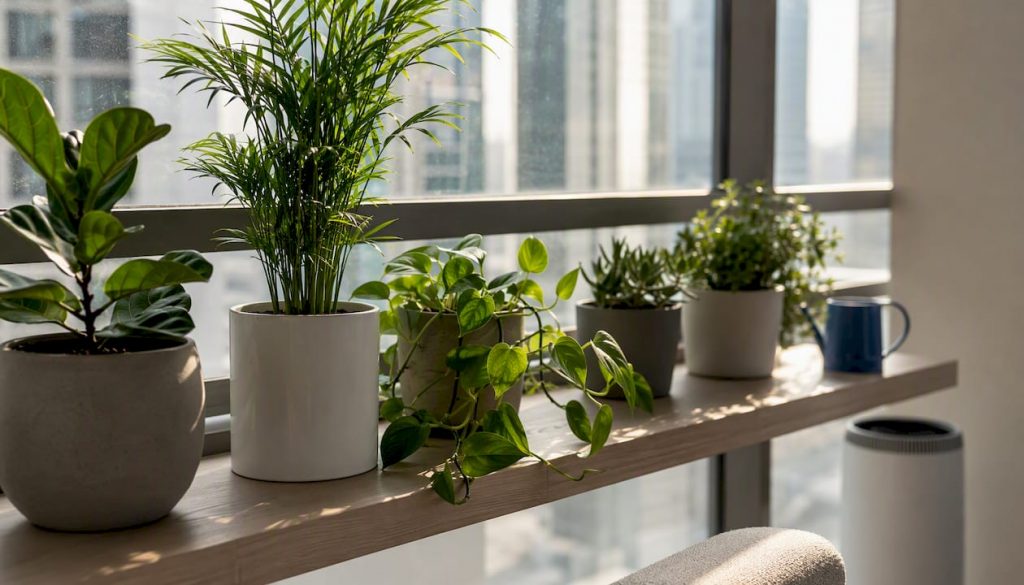
Yes, indoor air pollutants and incorrect humidity levels damage houseplants, and the fix starts with measurement, not shopping. A 2025 study on Epipremnum aureum (money plant) found that cigarette smoke causes measurable physiological decline, with a lethal dose around 6.4 cigarettes a day over 15 days of exposure. ASHRAE recommends that indoor relative humidity be maintained within a range suitable for most plants, generally between the low thirties and around 60 percent, and most heating and cooling systems push well outside that band. NASA’s early phytoremediation research showed leaves can absorb some volatile organic compounds, but nowhere near fast enough to matter in a real room.
Before buying anything, take these two actions:
- Measure first. A hygrometer and, ideally, an indoor air quality (IAQ) sensor tell you whether you’re dealing with a humidity problem, a pollutant problem, or both.
- Cut the source. Stop smoking indoors, ventilate after cleaning with solvents, and only then consider a purifier, humidifier or dehumidifier sized to the room.
Key Takeaways
Protecting indoor plants from air pollution and humidity stress requires measurement first, source control second, and correctly sized equipment third, in that order.
| Point | Details |
|---|---|
| Measure before buying | Use a hygrometer and, if possible, an IAQ sensor to confirm the actual problem before choosing a device. |
| Stop the source | Eliminate indoor smoking and ventilate after using solvents or strong cleaning products near plants. |
| Match device to problem | Use a HEPA and carbon purifier for smoke or VOCs, a humidistat humidifier for low RH, a dehumidifier for damp rooms. |
| Maintain on a schedule | Replace filters and clean humidifier reservoirs on a calendar, not when symptoms reappear. |
| Skip the myths | Misting and pebble trays barely raise RH; Climatepro’s HEPA and humidistat-equipped ranges address the actual causes measurement reveals. |
Table of Contents
- How indoor pollutants and humidity swings harm plant physiology
- Is it the air, or something else? A quick diagnostic check
- What plants can and can’t do to clean the air
- A step-by-step plan to protect your plants
- Choosing and maintaining devices for a plant zone
- A checklist to run daily, weekly and monthly
- How sensitive is each houseplant to indoor pollution?
- What years of low-level exposure do to a houseplant
- When heat, light and bad air stack together
- What actually drives our device recommendations
- Where to find the right equipment for your plants
- Frequently asked questions
- Sources
How indoor pollutants and humidity swings harm plant physiology
Houseplants react to bad air in ways you can measure long before the leaves look obviously sick. The main offenders indoors are cigarette smoke (a mix of particulates and gases), fine particulate matter (PM) settling on foliage, and volatile organic compounds (VOCs) like formaldehyde, toluene and acetone released from paint, furniture and cleaning products.
The clearest evidence comes from the 2025 Frontiers in Plant Science study on money plants, which tracked chlorophyll fluorescence and photosynthetic performance under smoke exposure. Researchers recorded declining photosynthetic efficiency, chlorophyll loss, and reduced leaf surface area as smoke concentration increased, with mortality rising sharply at higher doses. Particulates behave differently: a film of dust or smoke residue on the leaf surface blocks light and can partially clog stomata, the pores plants use to breathe and transpire. That reduces gas exchange and slows growth even when the plant isn’t being poisoned outright.
Statistic callout: The 2025 Epipremnum aureum smoke study found an LD50 (the dose lethal to half the test plants) of roughly 6.4 cigarettes a day over a 15 day exposure window, alongside measurable drops in leaf area and photosynthetic indices well before that threshold.
Humidity compounds the damage. HVAC systems dry indoor air in winter, and low relative humidity is a well documented driver of houseplant stress, producing brown leaf tips, curling edges and higher susceptibility to spider mites.
Watch for these humidity and pollutant symptoms together:
- Brown, crispy tips on tropical species like calathea or maranta usually point to low RH, not underwatering.
- A grey film on leaves near a kitchen or a smoking area suggests particulate deposition.
- Sudden leaf yellowing across a whole plant during heating season often tracks with a drop in ambient humidity, not a watering mistake.
Is it the air, or something else? A quick diagnostic check
Plant owners often blame watering for problems that are actually air related. Work through this sequence before changing your watering routine.
- Check the hygrometer and any IAQ reading first. If RH sits below 30% or an IAQ sensor flags elevated VOCs or PM, air quality is a plausible cause.
- Look at the damage pattern. Browning that starts at leaf tips and margins, spreading inward, points to humidity stress. Damage on one side of the plant only, facing a vent or window, suggests a localised draught or particulate source.
- Check the soil before blaming the air. Push a finger into the top few centimetres. Consistently soggy soil suggests root rot; bone dry soil for days suggests underwatering, not pollution.
- Note the timing. Symptoms that worsen every winter when the heating comes on are a strong humidity signal.
- Inspect leaf surfaces for a dull or dusty film. Wipe a leaf with a damp cloth. If it comes away grey or nicotine tinged, particulate deposition is a live issue.
Pro Tip: Always measure before you buy. A $15 hygrometer or a basic IAQ monitor tells you in minutes whether you actually need a humidifier, or whether the plant’s real problem is mineral salt buildup from tap water, which shows up as tip burn regardless of humidity.
Mineral salt crust on the soil surface, uneven watering, and low light all mimic air-quality symptoms.
What plants can and can’t do to clean the air
Plants make a measurable but modest contribution to air quality, and the numbers matter for anyone hoping a few pots of pothos will replace an air purifier. NASA’s original chamber experiments found Philodendron domesticum removed formaldehyde at rates of roughly 0.57 to 4.31 micrograms per square centimetre of leaf surface, depending on concentration, but those figures came from sealed test chambers, not living rooms with open doors and air currents.
More recent 2025 research on whole-plant and rhizosphere systems (the root zone and its microbial community) found that combining leaves, stems and root microbes speeds VOC removal compared with leaves alone. Even so, reported removal windows still ran 20 to 115 hours for common VOCs under controlled conditions. A single formaldehyde-releasing source in an open room will keep outpacing that.
That’s the practical gap between plant-based filtration and mechanical filtration:
- Speed: Plants work in hours to days; a HEPA and activated carbon purifier changes measurable air quality within minutes.
- Scale: One or two houseplants influence the air immediately around their leaves, not an entire office floor.
- Maintenance: Purifiers need filter changes; plants need root health, adequate light and the right humidity to keep contributing at all.
Plants are a genuine, evidence-backed complement to good air quality practice. They are not a substitute for source control and mechanical filtration, and the NASA record itself notes that scaling botanical filtration requires forced airflow and carbon media, essentially turning the plant into part of a mechanical system rather than a stand-alone solution.
A step-by-step plan to protect your plants
Work through this order rather than jumping straight to a device purchase.
- Remove the source. No indoor smoking near plants, and ventilate immediately after using paints, adhesives or strong cleaning products.
- Improve ventilation. Open windows when outdoor air quality allows, and check that vents aren’t blowing directly onto foliage.
- Measure. Log RH and, where possible, VOC or PM readings for a few days to establish a baseline.
- Match equipment to the problem. A dry room needs a humidifier; a room with lingering odours or VOCs needs a purifier with activated carbon; a persistently damp bathroom-adjacent plant nook needs a dehumidifier.
- Maintain what you install. Devices left unmaintained stop protecting plants long before their indicator lights admit it.
| Intervention | Primary role for plant health | Typical use case |
|---|---|---|
| HEPA + carbon air purifier | Removes particulates and VOCs from the air around foliage | Rooms with smoke history, new furniture, or strong odours |
| Humidifier with humidistat | Raises RH into the 30–60% ASHRAE range | Dry, heated rooms with tropical species |
| Dehumidifier | Lowers RH to prevent mould and fungal disease | Damp bathrooms, poorly ventilated plant corners |
| Hygrometer / IAQ sensor | Provides the data to decide which device is needed | Every plant zone, before any purchase |
Pro Tip: Skip the essential-oil diffuser near sensitive foliage. Air Purifier Labs and similar independent reviewers caution that the volatile compounds in diffuser oils can settle on and irritate leaf surfaces, and there’s no evidence they clean the air the way a HEPA and carbon filter does.
Misting gives a brief humidity bump that fades within an hour, and pebble trays barely shift the air around a pot. A properly sized humidifier with a humidistat is the only method that holds RH steady in a real room.
Choosing and maintaining devices for a plant zone
Sizing matters more than brand. Match a purifier’s clean air delivery rate (CADR) to the actual square metreage of the plant zone, not the whole apartment, and look for HEPA H13 filtration paired with an activated carbon layer if smoke or VOCs are the concern.
For humidifiers, a built-in humidistat that holds a target RH automatically beats a manual unit you have to check constantly. Keep the humidifier at least a metre from foliage; direct mist landing on leaves overnight raises local fungal risk rather than solving humidity stress.
Filter economics matter for ongoing plant health, not just running cost. A HEPA filter that’s overdue for replacement loses capture efficiency well before it looks visibly dirty, and a carbon filter saturated with VOCs stops adsorbing and can even release captured compounds back into the room. Rotate filters on a set calendar rather than waiting for a smell to return, and check compatible replacement filters for your specific unit before the change is due.
- Room match: Confirm CADR against room size before buying, not after.
- Filtration type: HEPA H13 for particulates and smoke; activated carbon layer for VOCs and odours.
- Run-time: Continuous low-speed operation during heating season protects plants better than short bursts on high.
- Cleaning cadence: Empty and rinse humidifier tanks every few days to prevent microbial growth in standing water.
Pro Tip: Measure, then act. Run the hygrometer for a week before deciding between a humidifier and a dehumidifier. Guessing wastes money and can push a room in the wrong direction entirely.
A checklist to run daily, weekly and monthly
Small habits prevent most of the damage described above from ever reaching a crisis point.
Daily
- Glance at the hygrometer.
- Check leaves for a dust or smoke film.
- Water only when the topsoil is actually dry.
Weekly
- Empty and clean humidifier reservoirs.
- Wipe leaf surfaces gently with a damp cloth.
- Check the purifier’s filter indicator light or airflow strength.
Monthly
- Review any logged IAQ or hygrometer data for trends.
- Schedule filter replacement if the indicator or calendar says it’s due.
- Check root health and soil surface for mineral salt crust.
How sensitive is each houseplant to indoor pollution?
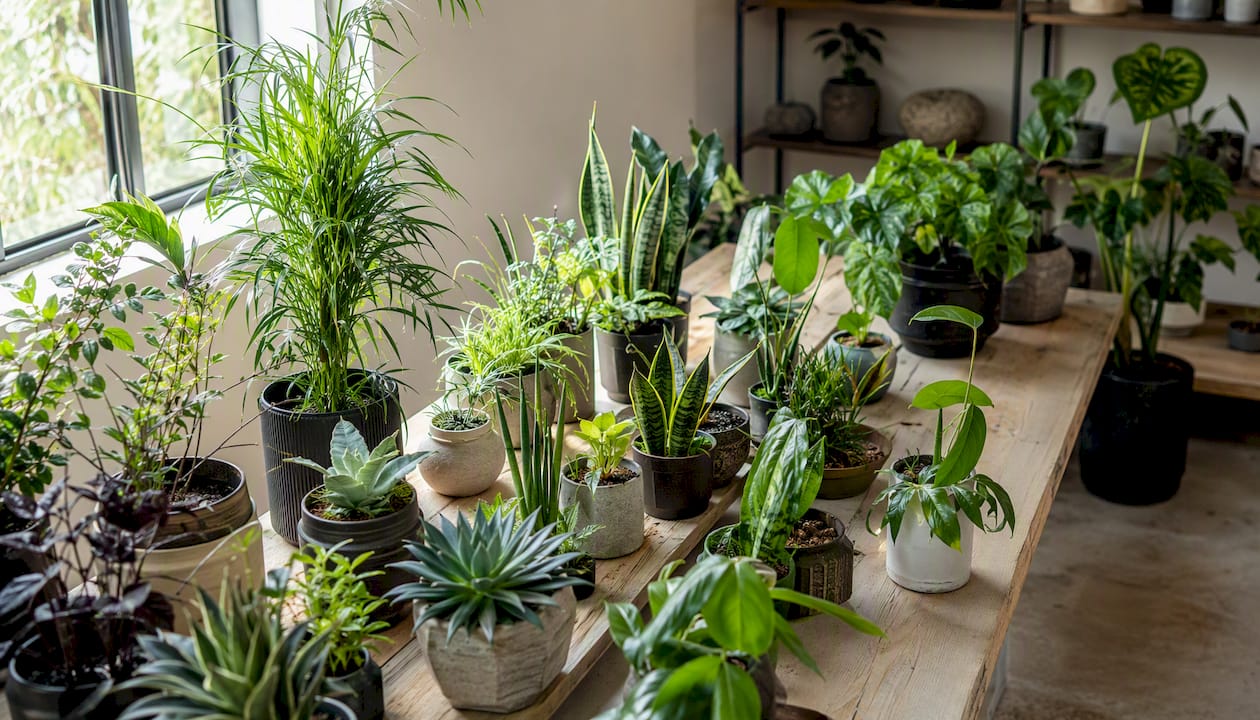
Sensitivity varies significantly by species, and knowing this helps you prioritise where to place monitoring or filtration first. Thin-leafed tropicals like calathea, maranta and ferns show humidity stress fastest, often within days of a heating system switching on, because their leaf tissue loses moisture quickly through open stomata. Money plants (Epipremnum aureum) sit in the middle: the 2025 smoke study used this species precisely because it tolerates a reasonable pollutant load before showing visible decline, yet still registers measurable chlorophyll loss well before symptoms are obvious to the eye.
Succulents and cacti tolerate low humidity comfortably but are still vulnerable to particulate film blocking their fewer, larger stomata. Snake plants and ZZ plants show unusual resilience to both low RH and moderate VOC presence, which is one reason they’re common in offices with imperfect air quality. Peace lilies, by contrast, wilt visibly under both drought stress and smoke exposure, making them a useful early-warning plant for a room with borderline air quality.
What years of low-level exposure do to a houseplant
A single smoky evening rarely kills a healthy plant. Chronic, low-level exposure is the more common real-world scenario, and it behaves differently to an acute dose. Repeated sub-lethal stress diverts energy toward damage repair and away from new growth, so a plant can survive for years while producing smaller leaves, longer gaps between new growth, and a gradually thinning canopy.
This slow decline is easy to misdiagnose as ageing or a nutrient deficiency, because it doesn’t present with the dramatic leaf browning that comes with an acute humidity crash. Reduced photosynthetic efficiency, documented in the smoke exposure literature even at levels well below the LD50 threshold, means the plant is running on a shrinking energy budget indefinitely. Over several years, that shows up as a shorter functional lifespan and a plant that never reaches the size or fullness it should for its age.
When heat, light and bad air stack together
Air pollutants rarely act alone. A plant already stressed by low winter humidity has less capacity to cope with a VOC spike from fresh paint or a smoke event, because both stressors draw on the same physiological response, closing stomata to limit water loss and gas exchange. Close the stomata to protect against dry air, and you also reduce the plant’s ability to process or tolerate airborne pollutants passing over the leaf surface.
Poor lighting compounds this further. A plant in low light is already photosynthesising below its potential, so the additional photosynthetic penalty from smoke or particulate exposure has a larger relative impact than it would on a well-lit, otherwise healthy specimen. Temperature swings near a draughty window or an air-conditioning vent add a third layer, since rapid temperature changes stress the same stomatal regulation system that humidity and pollutants already tax. The practical takeaway is that fixing one stressor in isolation, say, adding a humidifier while ignoring a nearby smoking habit or poor light, delivers a smaller improvement than addressing the combination.

What actually drives our device recommendations
I look at this problem the way a lot of plant owners eventually learn to: measurement beats assumption every time. The temptation is to buy a purifier or humidifier because a plant looks unhappy, but a hygrometer reading or a week of IAQ logging usually tells you which single change will fix most of the problem. Source control costs nothing and fixes more than any device can. Stop indoor smoking near plants, ventilate after using solvents, and only then look at equipment.
When a device is genuinely needed, sizing it to the actual room and plant density matters more than any brand claim. Climatepro’s role is to help UAE homeowners, office managers and indoor gardeners match HEPA H13 purifiers, humidistat-equipped humidifiers and dehumidifiers to the space they actually have, rather than guessing at capacity. That’s a curation job, not a hard sell, and it starts from the same measurement-first principle covered throughout this article.
Where to find the right equipment for your plants
Once you know whether your plant zone needs drying out, humidifying, or filtering, Climatepro’s air purifier range and humidifier category are built around exactly the room-matching approach this article recommends, with HEPA H13 and activated carbon options for smoke and VOC concerns.

If your plant corner runs persistently damp, particularly bathrooms or north-facing rooms with poor airflow, the dehumidifier range solves the opposite problem without overcorrecting into dry-air stress. Genuine replacement filters matched to your existing unit keep capture efficiency where it needs to be, since a saturated carbon filter stops protecting your plants long before it looks obviously worn. Match the device to the room size and plant density you actually have, then check Climatepro’s category pages to find a unit sized correctly rather than guessing.
Frequently asked questions
Does air pollution actually kill houseplants, or just slow their growth?
Both, depending on dose. The 2025 Epipremnum aureum study found measurable photosynthetic decline at low smoke exposure and a lethal dose at roughly 6.4 cigarettes a day over 15 days, meaning chronic low-level exposure stunts growth long before it becomes lethal.
Can I rely on houseplants alone to clean my indoor air?
No. Even whole-plant systems with active root microbes took 20 to 115 hours to process VOCs in controlled 2025 tests. Mechanical filtration works in minutes, so plants work best as a complement, not a replacement.
What humidity level is best for tropical houseplants indoors?
Are essential-oil diffusers safe to use around plants?
Use caution. Independent reviewers note the volatile compounds in diffuser oils can settle on leaf surfaces and potentially interfere with normal stomatal function, so keep diffusers away from sensitive foliage.
How do I know if my plant’s problem is air quality or watering?
Check the soil moisture first.
Sources
The claims in this guide draw on peer-reviewed plant physiology research and established extension and engineering guidance, useful reading if you’re justifying an office-wide air quality upgrade rather than a single pot on a windowsill.
- Effects of cigarette smoke on Epipremnum aureum — physiological and morphological impacts (Frontiers in Plant Science, 2025)
- Humidity and houseplants (Penn State Extension)
- Phytoremediation and botanical biofiltration findings (Elsevier, 2025)
- NASA studies on plant-based removal of VOCs and botanical biofiltration (NTRS)
- Botanical biofiltration and the role of whole plants and rhizosphere microbes (Building and Environment, 2025)
Check the humidity thresholds against your own hygrometer readings, and cross-reference species sensitivity before assuming every plant in a room needs the same fix.
Recommended
- How to improve indoor air quality at home in Australia — Blog | ClimatePro UAE
- Why healthy air matters: essential insights for Australians — Blog | ClimatePro UAE
- How air pollution affects animals: a guide for pet owners — Blog | ClimatePro UAE
- Air quality concepts explained: your 2026 guide — Blog | ClimatePro UAE