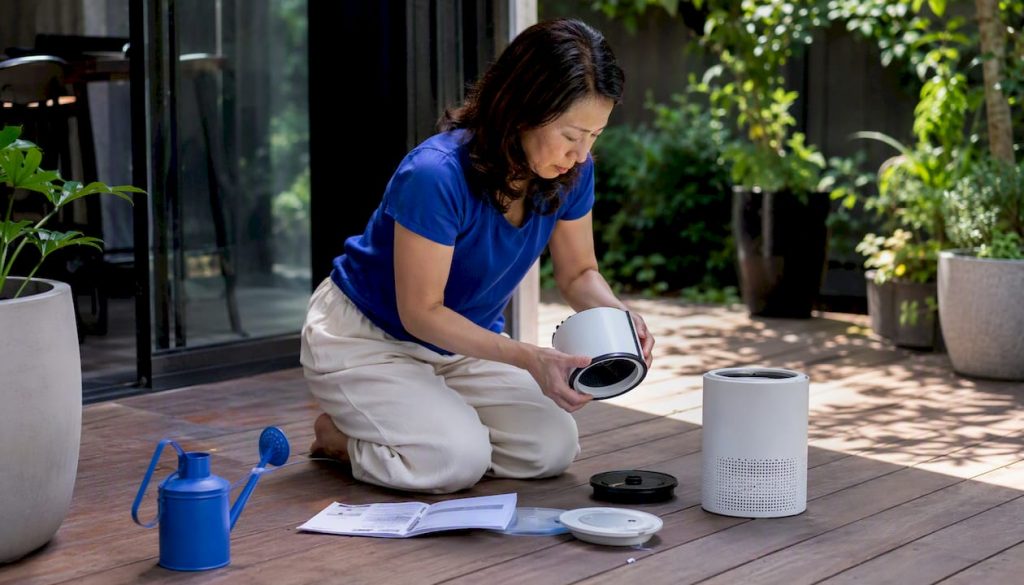
For most Australian buyers, the right starting point is a portable HEPA purifier with an activated carbon stage for home use, a higher-CADR unit or HVAC-integrated filter for offices, and a dedicated HEPA air scrubber for industrial or worksite environments. Each of these product classes solves a distinct problem, and choosing the wrong one wastes both money and effort.
Shortlist by use case:
- Home, allergies and fine dust: Portable HEPA purifier (H13-rated where available) with activated carbon stage. Typical unit price: a range suitable for different budgets
- Home, smoke and VOCs: Portable HEPA plus a substantial activated carbon bed. Carbon-only or HEPA-only units each fall short on their own.
- Small office or clinic: Higher-CADR portable unit or HVAC filter upgrade (MERV 13–16 or H13 pleated). Unit price: varies significantly depending on coverage.
- Large office or commercial building: Whole-building HVAC integration with deep-pleated MERV or HEPA-class media. Cost varies significantly by system size.
- Industrial worksite or workshop: HEPA air scrubber (H13/H14) or rigid pleated industrial filter. Units typically start at a higher price point suitable for industrial use.
- Odour and gas control (any setting): Activated carbon or molecular media stage, used alongside HEPA, not instead of it.
Table of Contents
- What do air filtration products actually cover?
- How do common air filtration products compare?
- How do you choose the right air filtration product?
- What does it cost to own and maintain air filtration equipment?
- Where does filtration fit alongside ventilation and source control?
- Which technical specs should you verify before buying?
- Key takeaways
- The case for getting the basics right before upgrading
- Sources and further reading
- Climatepro: portable HEPA purifiers and replacement filters
What do air filtration products actually cover?
The term covers several distinct product classes, and they do not all solve the same problem. Understanding the difference before purchasing prevents a common and costly mistake.
Portable HEPA room purifiers are the most widely sold category in Australia. Brands such as IQAir, Blueair, and Camfil all offer portable units suited to residential and light-commercial spaces. These capture fine particles, pollen, dust mite debris, and smoke particulates effectively. What they cannot do is remove gases, VOCs, or odours unless paired with an activated carbon stage.
Activated carbon and molecular media address what HEPA cannot. Carbon beds adsorb gases, cooking odours, VOCs, and some chemical fumes. HEPA for particles and activated carbon for VOCs is the standard recommendation from industrial hygiene specialists. The two media work together, not interchangeably.
Whole-house and HVAC filters include pleated MERV-rated media and H13-class drop-in replacements for ducted systems. Deep-pleated designs extend filter life and improve capture compared with standard 25 mm furnace filters. Thorair supplies HVAC-compatible filter solutions to the Australian market, including custom-sized pleated media for commercial installs.
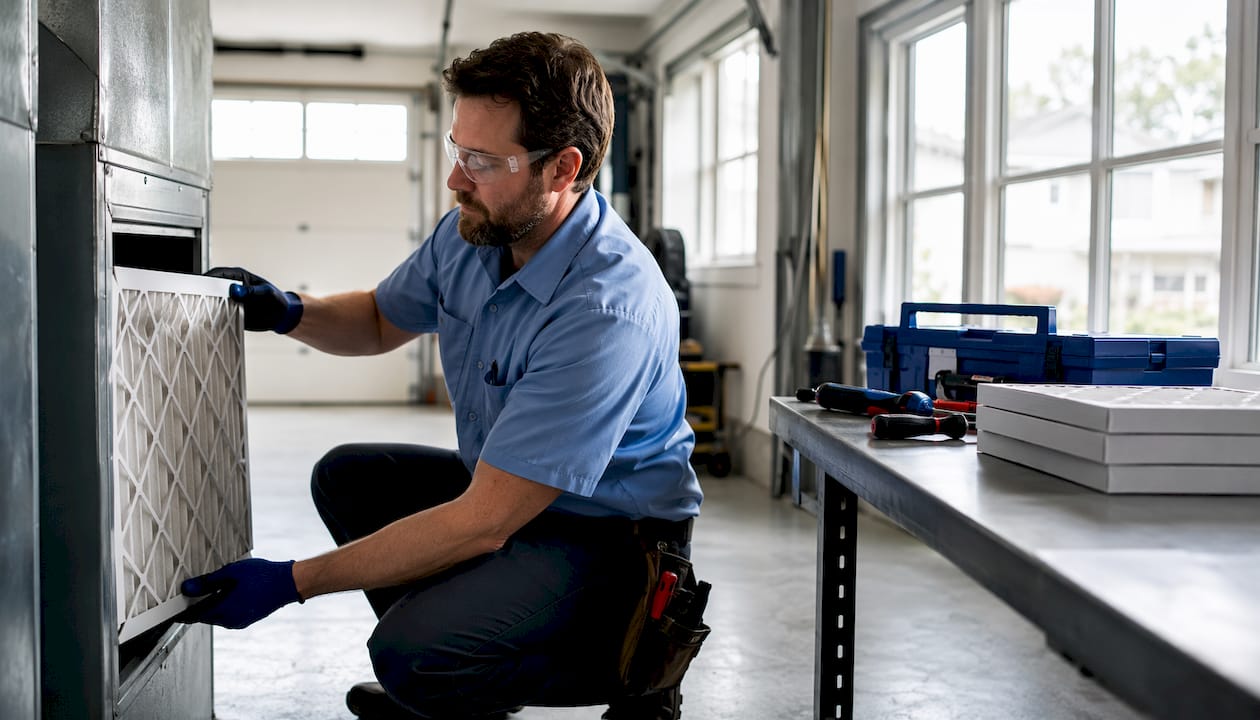
Pre-filters sit upstream of the main media to capture coarse dust and hair, extending the life of the more expensive HEPA or carbon stages.
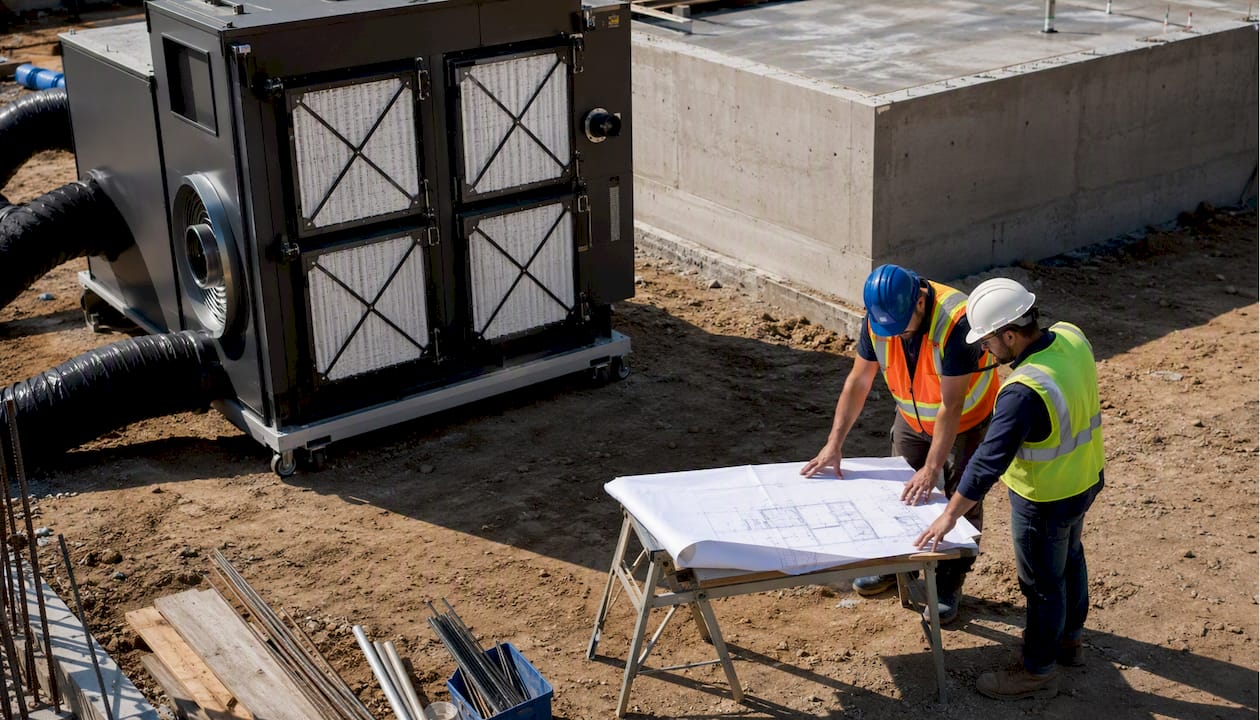
Industrial air scrubbers are self-contained units that draw large air volumes through H13 or H14 HEPA media. They are standard on construction sites, in remediation work, and in workshops where fine dust or chemical fumes are generated continuously.
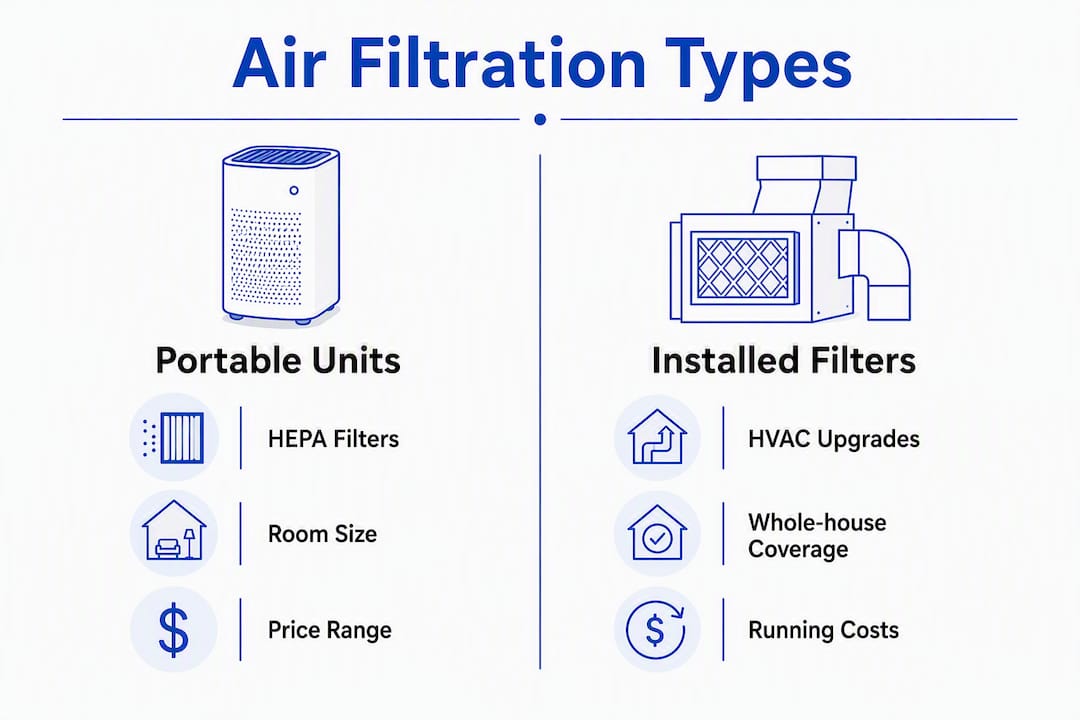
Pro Tip: If you are deciding between a portable unit and HVAC integration for an office or large home, consider runtime. A portable unit only cleans the air in the room where it sits. An HVAC-integrated filter treats every cubic metre of air passing through the duct system, making it the more practical choice for continuous occupancy across multiple rooms.
How do common air filtration products compare?
The table below covers the four main product classes Australian buyers encounter, mapped against the criteria that matter most at the point of purchase.
| Product class | Best for | Room size / CADR | Filter media | Noise | Unit price (AUD, indicative) | Running cost | Warranty / local support | Energy use |
|---|---|---|---|---|---|---|---|---|
| Portable HEPA purifier | Allergies, fine dust, smoke particles | — / CADR rated per model | H13 HEPA + activated carbon pre-filter | 25–55 dB (sleep to full speed) | A range suitable for different budgets | Ongoing filter replacement cost varies widely | 1–3 yr; IQAir and Blueair have AU service | Low–moderate |
| Whole-house / HVAC filter | Whole-building particle control | Whole home / matched to system airflow | MERV 13–16 or H13 pleated | Near-silent (fan noise only) | — | —/yr depending on MERV and size | Varies; Camfil and Thorair supply AU market | Moderate (pressure drop adds fan load) |
| Activated carbon stage | Odours, VOCs, gases | Paired with HEPA unit | Activated carbon / molecular media | Nil (passive or paired) | — | $80–$200/yr | Depends on parent unit brand | Negligible |
| Industrial air scrubber / HEPA H13–H14 | Workshop dust, remediation, construction | Large open areas / high CADR | H13–H14 HEPA, pre-filter | 55–75 dB at full load | — | —/yr (heavy-use environments) | Camfil and Thorair have AU commercial support | High (continuous high-volume fan) |
Brand availability note: IQAir and Blueair units are stocked by multiple Australian retailers and carry local warranty support. Camfil operates directly in Australia with commercial and industrial supply. Thorair supplies HVAC and industrial filtration media to the Australian market, including custom-sized pleated filters.
Higher filtration efficiency at MERV 16 or HEPA class commonly increases pressure drop across the filter, which raises fan energy consumption. For HVAC retrofits, this trade-off needs to be assessed before specifying a denser media grade.
Key trade-offs to keep in mind:
- HEPA captures particles; it does not remove gases or odours without a carbon stage.
- Higher MERV or HEPA class means greater pressure drop, which increases fan energy use and can stress older HVAC fans.
- Portable units provide fast local relief but do not treat an entire building’s air volume.
- Whole-system HVAC solutions treat the full air volume passing through the ventilation circuit and can outperform table-top units for continuous multi-room coverage.
How do you choose the right air filtration product?
Work through these questions in order before selecting a product class.
- Identify the primary pollutant. Fine particles (dust, pollen, pet dander, smoke)? Gases or odours (cooking, VOCs, chemical fumes)? Both? Particles call for HEPA; gases call for activated carbon; most real-world situations need both.
- Measure the room or space. Calculate floor area in square metres and multiply by ceiling height to get volume. For a standard 3 m ceiling, a 30 m² bedroom has 90 m³ of air to treat.
- Match CADR to room size. A simple rule of thumb: the unit’s CADR (in m³/hr) should be at least two-thirds of the room volume to achieve adequate air changes per hour. For a typical bedroom, most mid-range portable purifiers will meet this need.
- Consider source proximity. A portable unit placed near the source (a pet bed, a printer, a cooking area) performs significantly better than one placed across the room. Portable air cleaner effectiveness depends on both collection efficiency and the air flow rate through the device.
- Assess runtime and occupancy. A bedroom unit running eight hours overnight is adequate for most allergy sufferers. A clinic or office with continuous occupancy needs either a high-CADR portable unit or HVAC integration.
- Set a realistic budget including running costs. Filter replacement is the largest ongoing cost. A unit with cheap replacement filters and a two-year filter life costs less over five years than a premium unit with expensive, annual replacements.
- Check noise tolerance. Bedrooms typically require units that operate below 35 dB on sleep mode. Industrial scrubbers are not suitable for quiet environments.
Installation note for HVAC systems: Upgrading to a higher-MERV or H13 filter in an existing ducted system requires checking the system’s fan capacity. Custom filter housings and media specification are often required for industrial applications to maintain airflow and static pressure balance. Retrofitting without assessing pressure drop can damage fans or void equipment warranties. For commercial installs, a qualified HVAC technician should confirm compatibility.
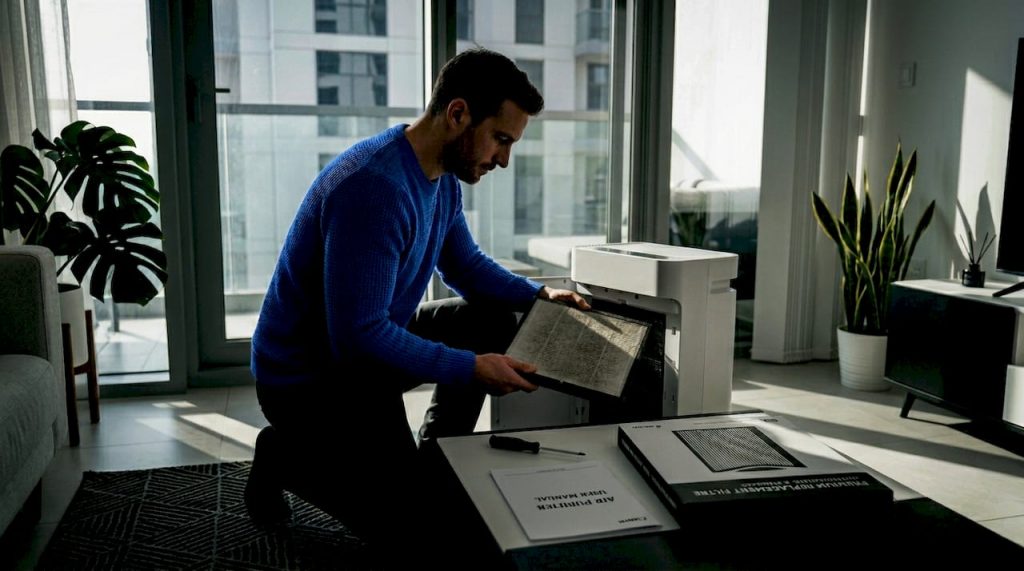
Pro Tip: When buying for an Australian home, check that the seller stocks replacement filters locally. A unit that requires overseas-sourced filters can sit idle for weeks during a bushfire smoke event, which is precisely when you need it most.
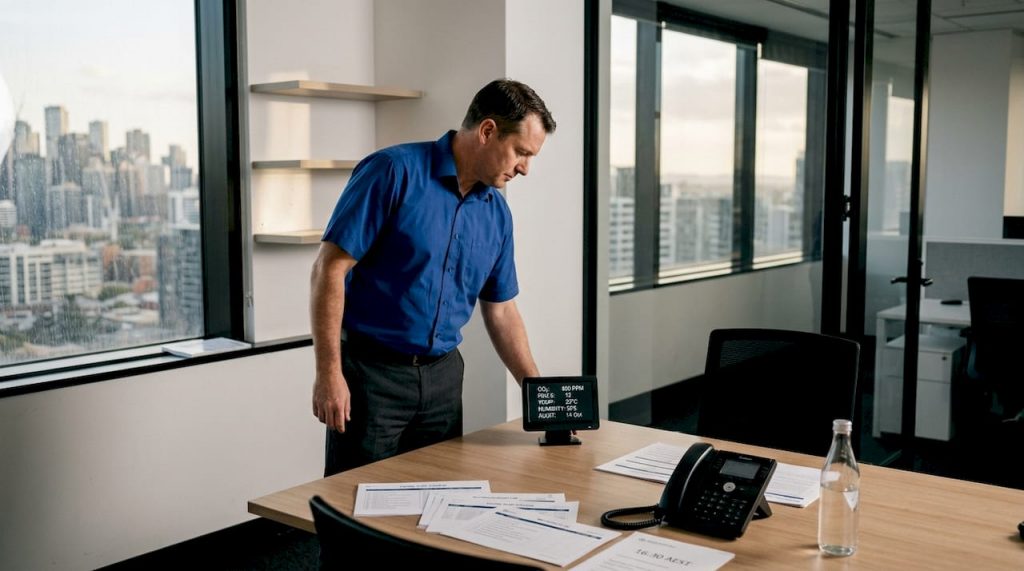
For office air quality improvement, pairing HVAC filter upgrades with portable units in high-occupancy areas gives the most consistent results.
What does it cost to own and maintain air filtration equipment?
Purchase price is only part of the calculation. Filter replacement, energy, and occasional servicing determine the real cost over a three-to-five-year ownership period.
| Product class | Typical unit cost (AUD) | Replacement filter cost (AUD) | Replacement frequency | Annual filter cost (AUD, indicative) |
|---|---|---|---|---|
| Portable HEPA purifier | A range suitable for different budgets | — | 6 months (HEPA); 3–6 months (carbon) | — |
| HVAC pleated filter (MERV 13–16) | — | — | 3–6 months depending on load | — |
| Activated carbon stage (standalone) | — | — | 3–6 months | — |
| Industrial air scrubber (H13/H14) | — | — | 3–6 months under heavy use | — |
What shortens filter life:
- Smoking indoors or near the intake.
- High pet ownership (dander and hair load the pre-filter rapidly).
- Workshop or renovation dust (industrial loads can exhaust a HEPA stage in weeks).
- Coastal or humid environments, where moisture can promote growth on filter media. Filters with antimicrobial treatment, such as those incorporating Spor-Ax® binder technology, resist mould and bacteria growth and are worth specifying for humid Australian climates.
Maintenance checklist:
- Clean or replace the pre-filter every 4–8 weeks in high-load environments.
- Replace HEPA and carbon stages on the manufacturer’s schedule, not just when the indicator light triggers.
- For HVAC installs, check static pressure readings after a filter change to confirm the new media is not overloading the fan.
- Dispose of used HEPA filters sealed in a bag; do not shake them out.
- Store replacement filters in their original packaging, away from moisture.
Pro Tip: Reusable pleated filters with antimicrobial media can reduce landfill impact and lifecycle cost in professional settings, provided they are cleaned and maintained correctly. Check whether the manufacturer specifies a maximum wash cycle count and follow it.
Energy running costs are a secondary but real factor. Higher-efficiency media increases pressure drop, which raises fan energy consumption. For a whole-house HVAC system running year-round, the difference between a MERV 8 and a MERV 16 filter can add meaningfully to annual electricity bills. An energy-efficient air cleaning approach balances capture efficiency against fan load rather than simply specifying the densest available media.
Where does filtration fit alongside ventilation and source control?
Filtration is one of three foundational strategies for improving indoor air quality. The US EPA framework names source control, improved ventilation, and air cleaning or filtration as the three approaches, and rates source control as typically the most effective for residential settings.
In practice, this means:
- Source control first. Remove or reduce the pollutant at its origin. Switch to low-VOC paints, fix damp that causes mould, ban smoking indoors, and service gas appliances. No filter compensates fully for a persistent, uncontrolled source.
- Ventilation second. Bringing in fresh outdoor air dilutes indoor pollutants. Ventilating your home efficiently reduces the filtration load and improves overall air quality at lower cost than running a purifier continuously.
- Filtration third. Once sources are controlled and ventilation is adequate, filtration handles residual particles, allergens, and odours that ventilation alone cannot remove.
There are situations where filtration moves to the front of the response. During Australian bushfire smoke events, outdoor air quality can be worse than indoor, making ventilation counterproductive. In those conditions, sealing the building and running a HEPA purifier at high CADR is the correct approach. Similarly, for allergy sufferers in high-pollen seasons, filtration provides relief that source control and ventilation cannot fully deliver.
Pro Tip: For fast local relief in a single room, a portable HEPA purifier placed near the occupant is the most practical immediate measure. For long-term, whole-building improvement, HVAC-integrated filtration is the more cost-effective and consistent solution.
Which technical specs should you verify before buying?
Marketing claims on air filtration products vary widely. These are the specifications worth checking against independent data.
Critical specs to verify:
- HEPA class: H13 captures at least 99.95% of particles at 0.3 µm; H14 captures 99.995%. Many products advertise “HEPA performance” without stating the class. Verify HEPA class and independent lab test results rather than relying on marketing copy alone.
- EN 1822: The European standard for HEPA and ULPA filter testing. H13/H14 classification under EN 1822 is the most widely recognised benchmark for high-efficiency media.
- CADR: Measured in m³/hr or CFM, CADR tells you how much clean air the unit delivers per hour for a specific pollutant (smoke, dust, pollen). Manufacturer-rated room coverage figures are only meaningful when the underlying CADR is stated.
- MERV rating: For HVAC filters, MERV 13 is the minimum recommended for meaningful particle capture; MERV 16 approaches HEPA-class performance but increases pressure drop.
- Pressure drop: Higher-efficiency media creates greater resistance to airflow. For HVAC retrofits, confirm the system fan can handle the increased static pressure before specifying a denser filter.
- Published filter life: Check the manufacturer’s stated filter life under rated conditions, not best-case conditions.
Numbered verification checklist:
- Confirm HEPA class (H13 or H14) is stated, not just “HEPA-type” or “HEPA-style.”
- Check whether CADR is independently tested or manufacturer-stated.
- For HVAC filters, confirm MERV rating and pressure drop data.
- Ask the seller for lab test reports or third-party certification where the application is critical (clinics, cleanrooms, industrial sites). For healthcare filtration applications, H13/H14 compliance documentation is standard practice.
- Confirm local warranty terms and that replacement filters are stocked in Australia.
- Check whether the unit carries ENERGY STAR certification for energy efficiency.
Australian buyers should note that AS/NZS standards apply to some electrical safety aspects of air purifiers sold in Australia. For filter media performance, EN 1822 and ASHRAE 52.2 (for MERV) remain the relevant international benchmarks. When purchasing for regulated environments such as hospitals or food production facilities, ask vendors for the specific test reports applicable to the media grade.
Key takeaways
Matching product class to pollutant type and room size is the single most important decision when buying air filtration equipment in Australia.
| Point | Details |
|---|---|
| Match product to pollutant | HEPA captures particles; activated carbon removes gases and odours. Most spaces need both. |
| Size units to the room | Ensure the CADR (m³/hr) matches the room volume for effective air cleaning. |
| Budget for running costs | Filter replacement adds a material running cost per year depending on product class and usage intensity. |
| Verify specs, not claims | Confirm H13/H14 HEPA class, CADR, and local filter availability before purchasing. |
| Climatepro for purchase | Climatepro stocks portable HEPA purifiers and replacement filters with delivery across the UAE. |
The case for getting the basics right before upgrading
Most buyers focus on the unit itself and underestimate the importance of filter availability and local support. A premium IQAir or Camfil unit is a sound investment when genuine replacement filters are stocked locally and the warranty is honoured in Australia. The same unit becomes a liability if a filter change requires a six-week international order.
The pressure-drop trade-off is also underappreciated. Specifying the highest available MERV or HEPA grade for an HVAC retrofit sounds like the safest choice, but it can overload an older fan motor, increase annual electricity costs, and void the HVAC warranty. A MERV 13 filter that the system handles comfortably will outperform a MERV 16 filter that causes the fan to cycle irregularly or bypass air around the frame.
One practical example: choosing a lower pressure-drop pleated HVAC filter over a denser alternative reduced fan energy consumption in a commercial installation without meaningfully compromising particle capture for the target pollutant. The filter life was also longer because the reduced airflow resistance kept the media from compressing prematurely.
Sources and further reading
The following resources support the guidance in this article and are useful for deeper research.
- US EPA: Improving Indoor Air Quality — the primary reference for the source control, ventilation, and filtration framework.
- TSI: 10 Strategies for Enhancing Indoor Air Quality — practical guidance on HEPA and carbon media selection.
- ENERGY STAR Certified Room Air Cleaners — searchable database of certified units with CADR and energy data.
- AirFidelity technical notes — pressure drop and energy trade-off analysis for high-efficiency media.
- Climatepro air purifiers catalogue — portable HEPA purifiers and replacement filters available for purchase.
- Climatepro main catalogue — full range of air quality products including humidifiers and dehumidifiers.
When researching specific models, prefer independent lab reports and local warranty documentation over manufacturer marketing materials. For regulated environments, request the EN 1822 test certificate for the specific filter batch, not just the product line.
Climatepro: portable HEPA purifiers and replacement filters

Climatepro stocks a curated range of portable HEPA purifiers and genuine replacement filters for homes, offices, clinics, and commercial spaces. The range includes units suited to bedrooms and living areas through to higher-CADR models for larger open-plan spaces. Replacement filters are stocked alongside the units, so buyers are not left searching for compatible media after purchase.
For buyers coming from this guide, the practical starting point is a portable HEPA air purifier matched to the room size and primary pollutant. The Honeywell Air Touch P2 and P1 are well-suited to bedrooms and mid-size living areas, while the Honeywell Air Touch U1 covers larger spaces with a higher CADR rating. Blueair replacement filters, including the Classic 400 Series DualProtection Filter, are stocked for ongoing maintenance.
Browse the full range at climatepro.ae or go directly to the air purifiers section to filter by room size and coverage.