An activated carbon filter removes gases, odours and many organic chemicals through adsorption, where contaminants stick to a vast internal pore surface rather than passing through it. It works best on chlorine taste, VOCs and smells in air or water, but it cannot catch fine particles, bacteria, fluoride or dissolved minerals. Pair it with HEPA filtration for airborne dust or with reverse osmosis for inorganic water contaminants to cover those gaps.
TL;DR:
- Activated carbon effectively removes gases, odors, and organic chemicals but cannot trap fine particles, bacteria, fluoride, or dissolved minerals.
- Its performance depends on pore size distribution, surface chemistry, contact time, and flow rate, requiring careful pairing with other filtration systems for comprehensive coverage.
- Different forms like granular, powdered, extruded, and solid block carbon target specific applications such as water, air, or industrial uses, with longevity depending on usage and contaminant levels.
- Regular replacement is critical to prevent bacterial growth and breakthrough, typically every three months for air purifiers and several months for water filters, based on usage.
- Combining activated carbon with HEPA, reverse osmosis, or ion exchange enhances overall filtration, as each technology addresses a different contaminant category.
Table of Contents
- How activated carbon works: activation, pore structure and adsorption
- Applications compared: air purification versus water treatment
- Common types of activated carbon and where each fits
- What activated carbon removes and what it does not
- Maintenance and life expectancy: when to replace carbon filters
- Quick checklist: choosing the right activated carbon filter
- How activated carbon filters are regenerated or disposed of
- Certifications and standards to look for
- Health and safety considerations
- How activated carbon compares with other filtration technologies
- ClimatePro’s take on choosing and maintaining carbon filters
- Get the right filter without the guesswork
- Sources
How activated carbon works: activation, pore structure and adsorption
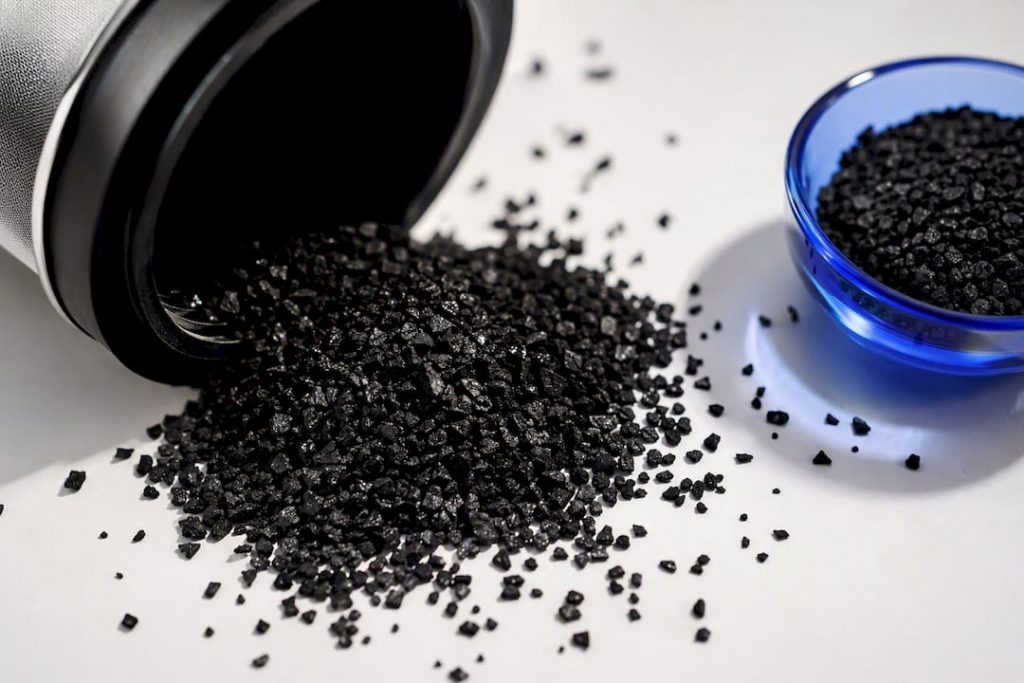
Activated carbon starts as a carbon source, usually coconut shell, coal or wood, that gets heated with steam or treated chemically without oxygen. This activation process burns away impurities and opens up an enormous network of microscopic pores. The result is a material with staggering internal surface area, sometimes exceeding thousands of square metres per gram, packed into a granule you could hold in your palm.
That surface area is the whole story. Gas molecules and dissolved organic compounds are drawn to the pore walls through weak molecular attraction and stick there, a process called adsorption. This differs from absorption, where a material soaks something into its bulk the way a sponge takes up water. Adsorption happens only at the surface, which is exactly why pore structure matters so much.
Activation by heat or steam without oxygen produces the fine pore network responsible for two removal mechanisms working side by side: adsorption and a slower catalytic reduction of certain compounds. Neither is unlimited. Every pore eventually fills, so capacity runs out as the filter ages.
Four factors decide how well a given carbon performs: the distribution of pore sizes relative to the target molecule, the surface chemistry of the carbon (plain versus chemically treated), how long the contaminant sits in contact with the media, and how fast air or water moves through the bed. Slow the flow rate and you extend contact time, which usually improves removal, but it also increases pressure drop in air systems or reduces throughput in water systems.
Applications compared: air purification versus water treatment
Carbon behaves differently depending on whether it is filtering gas or liquid, and the design goals split accordingly.
In air purification, carbon targets volatile organic compounds, cooking smells, smoke and other odour molecules, not dust or pollen. Most household units place a thin carbon layer or cartridge ahead of or behind a mechanical filter stage. Activated carbon handles gases while a HEPA filter captures particles down to 0.3 microns, which is why the two rarely appear alone in a well-designed unit. A carbon pre filter ahead of a HEPA stage also protects the finer filter from oil and smoke residue.
Water treatment asks something different of the same base material. Point-of-use systems (a jug or tap filter) and point-of-entry systems (whole-house units) both rely on contact time and bed depth to strip out chlorine taste, odour and many organic compounds. A thin cartridge with water rushing through it removes far less than a deep bed with a slow flow rate.
The trade-offs diverge from there. Air systems are managed by balancing airflow against pressure drop, since a denser carbon bed cleans gas more thoroughly but strains the fan and raises noise. Water systems are managed by balancing flow rate against carbon mass, since rushing water through too little media lets contaminants pass through untouched.
Common types of activated carbon and where each fits
Not all activated carbon is built the same way, and the format usually signals the job it is meant for.
Granular activated carbon (GAC) is loose granules commonly used in household water filters and larger air-handling beds. It offers a good balance of surface area and low resistance to flow, making it the standard choice for household water treatment.
Powdered activated carbon (PAC) is far finer, giving it more surface area per gram, but it is typically dosed into water treatment processes rather than packed into a cartridge, since its fine particle size would clog most filter housings.
Extruded and pellet carbons are shaped for gas-phase work. Their uniform structure keeps pressure drop low, which suits HVAC carbon beds and industrial air scrubbers where airflow matters as much as removal efficiency.
Solid block activated carbon (SBAC) compresses carbon into a rigid cartridge that can also trap certain parasitic cysts like Giardia and Cryptosporidium alongside its usual adsorption work.
Impregnated carbons are chemically treated to target specific troublesome gases such as hydrogen sulphide or ammonia, extending their reach well beyond general VOC removal into odour problems that plain carbon handles poorly.
What activated carbon removes and what it does not
Getting the expectations right here saves buyers money and disappointment in equal measure.
Activated carbon reliably reduces chlorine taste and smell, a broad range of VOCs, cooking and pet odours, some pesticides, and various disinfection by-products in water. On the air side, it is genuinely effective against the gases that cause lingering smoke, paint and chemical smells that mechanical filters simply pass through.
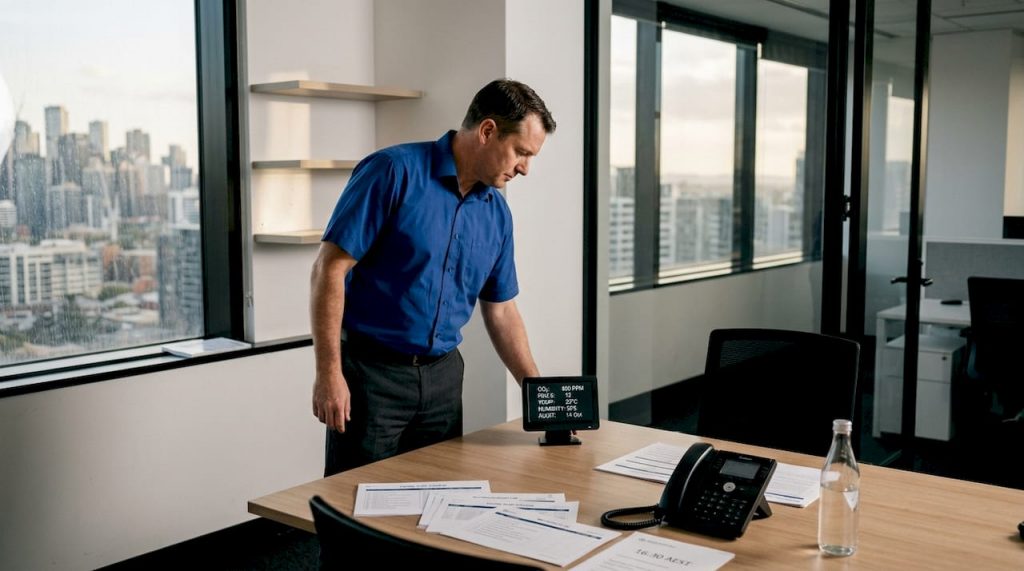
What it will not do is just as important. Activated carbon does not remove bacteria, nitrate nitrogen, fluoride, chloride or water hardness, since none of those adsorb onto carbon’s pore surfaces the way organic molecules do. On the air side, carbon has no mechanism for capturing fine particulate matter like PM2.5, pollen or dust, which is purely a job for mechanical filtration.
There is a hidden risk too. Saturated carbon that has accumulated organic material can become a breeding ground for bacteria, turning a filter you haven’t replaced into a source of contamination rather than a barrier against it. Once a carbon bed reaches its adsorption capacity, contaminants begin passing straight through in what is called breakthrough, often with no obvious warning sign until taste or odour returns. That’s the core argument for prefiltration and disciplined replacement schedules rather than running a cartridge until it visibly fails.
Maintenance and life expectancy: when to replace carbon filters
Carbon filter lifespan depends heavily on what is passing through it, but there are workable rules of thumb.
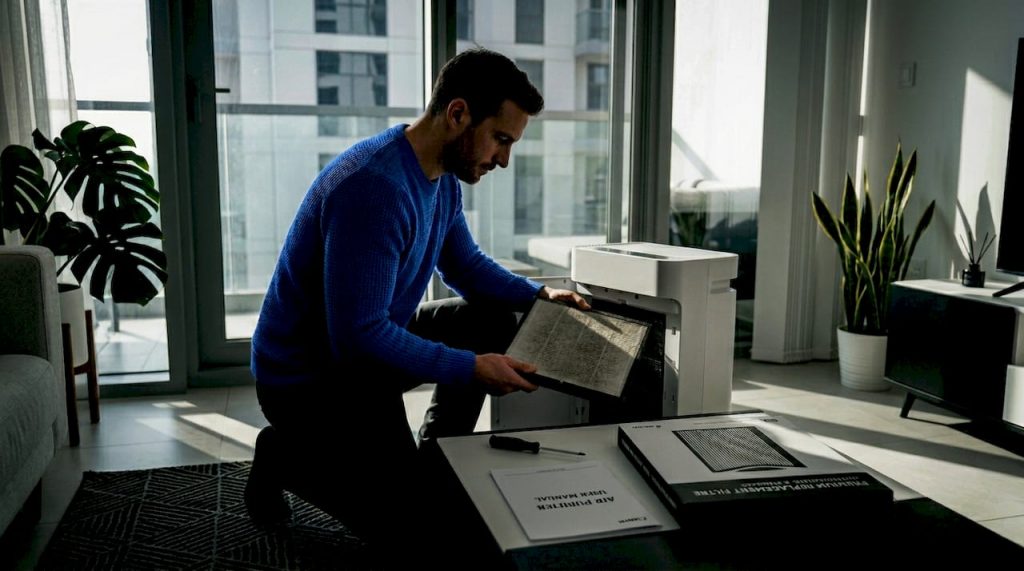
For air purifiers, carbon cartridges typically need replacing about every three months, noticeably more often than the mechanical or HEPA stage in the same unit, because odour-causing gases saturate the pore structure faster than particles clog a filter mat. Water filter cartridges can be used for several months, but that range depends heavily on water quality and household usage, so treat it as a starting point rather than a fixed rule.
Watch for these signs that a carbon filter replacement is overdue:
- Odours or chlorine taste returning despite the filter still being installed.
- Noticeably reduced airflow or a change in fan noise from an air purifier.
- Slower water flow through a tap or whole-house cartridge.
- A cartridge older than the manufacturer’s stated interval, regardless of how it smells or performs.
Pro Tip: Keep a simple log with the install date taped to the unit or written in your phone. Carbon saturation is invisible until it fails, so a date beats guesswork every time.
A sediment prefilter ahead of a water carbon cartridge extends its working life significantly by keeping grit and rust out of the pores meant for organic molecules.
In air systems, avoid gaps around the cartridge edge, since air will always take the path of least resistance and channel around carbon rather than through it if the seal isn’t tight.
Quick checklist: choosing the right activated carbon filter
Work through this list before buying, whether the target is an odour problem in a room or a taste problem at the tap.
- Identify the primary job first. An air odour or VOC problem calls for a carbon-equipped air purifier or HVAC carbon bed; a chlorine taste or organic chemical problem in water calls for a GAC or block carbon cartridge.
- Check contact time and flow rate specs for water filters. A cartridge rated for a slow drip removes more than one designed for full household flow at the same carbon mass.
- Check carbon mass and bed depth, not just cartridge size. A bulkier housing with more carbon inside will outlast and outperform a slim one on the same water quality.
- Pair carbon with HEPA for air, or with reverse osmosis or ion exchange for water inorganics. Carbon alone never solves particle or mineral problems.
- Budget for replacements, not just the initial purchase. Confirm your local supplier stocks the exact replacement cartridge for your model before committing to a system.
How activated carbon filters are regenerated or disposed of
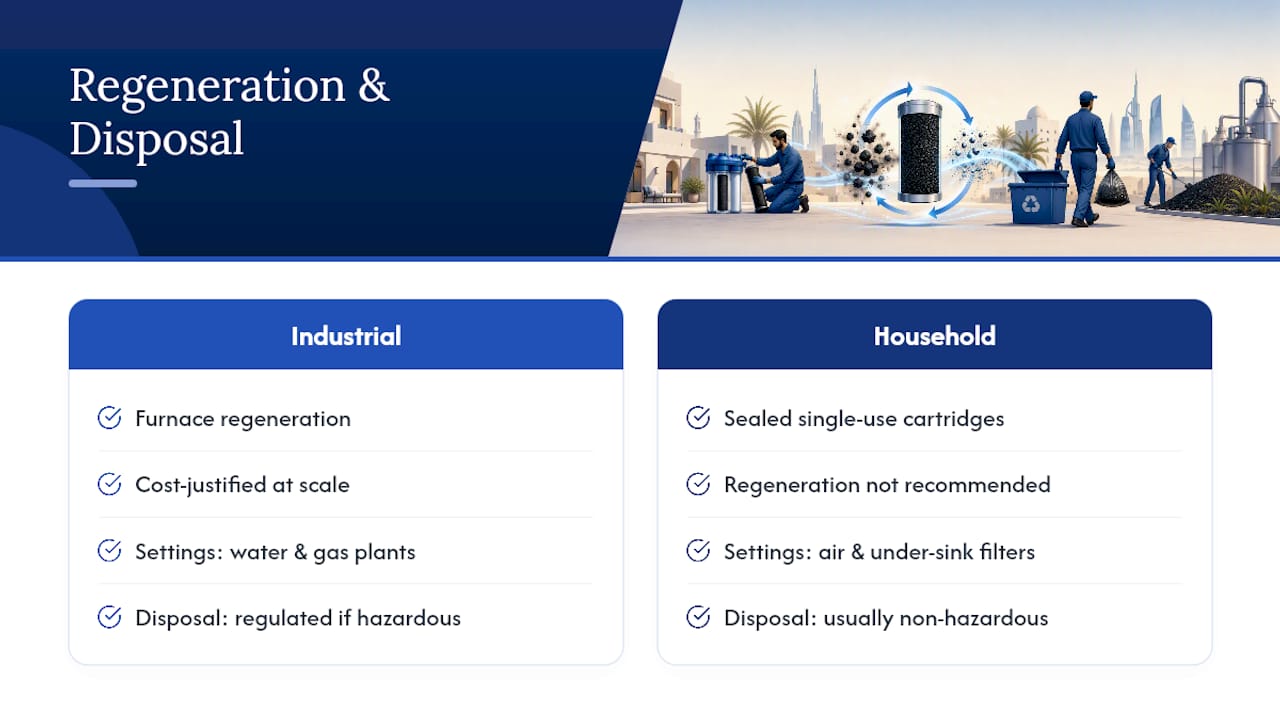
Industrial-scale carbon regeneration involves heating spent carbon in a furnace to drive off the trapped contaminants and reopen the pore structure, effectively repeating the original activation process. This is common in large water treatment plants and industrial gas-scrubbing operations, where the volume of carbon justifies the cost of regeneration equipment.
For household cartridges, regeneration isn’t practical or recommended. The carbon media inside a consumer air purifier or under-sink water filter is sealed into a housing designed for one-time use, and attempting to clean or reactivate it at home won’t restore meaningful capacity. The standard path for household units is straightforward replacement on the schedule recommended for that filter type.
Disposal is generally uncomplicated since spent activated carbon from residential water or air filtration is not classified as hazardous waste in most households, though local waste guidelines should always take precedence. Cartridges used in industrial settings, particularly those that have adsorbed heavy metals or specific hazardous chemicals, may fall under different disposal rules and should be handled according to the facility’s own waste protocols. When in doubt about a specific cartridge, checking the manufacturer’s disposal guidance printed on the packaging is the simplest way to avoid uncertainty.
Certifications and standards to look for
Two certification bodies dominate the credibility conversation around carbon filtration, and knowing the difference helps you read a product label properly.
NSF International certifies water filters against specific standards. NSF/ANSI 42 covers aesthetic effects, meaning chlorine taste, odour and clarity, while NSF/ANSI 53 covers health effects, meaning contaminants with an established health-based limit such as certain VOCs or pesticides. A carbon filter certified to 53 has been independently tested to reduce a named list of contaminants below specific thresholds, not just to make water taste better.
ANSI, the American National Standards Institute, doesn’t test products itself but accredits the standards NSF and similar bodies use, giving the certification process a recognised framework rather than an arbitrary one.
For air purifiers, there isn’t an equivalent single carbon-specific certification most consumers will encounter. Instead, look at how much carbon a unit actually contains, since manufacturers sometimes include a token layer that offers minimal odour reduction. A heavier carbon cartridge, or one specifically described as impregnated for a target gas, generally signals a more genuine gas-phase filtration stage than a thin mesh dusted with carbon granules.
Certification numbers on packaging are worth checking against the specific contaminant list the standard covers, since a filter certified for chlorine taste under NSF/ANSI 42 says nothing about its performance against, say, lead or pesticides.
Health and safety considerations
Activated carbon itself is chemically inert and widely regarded as safe to handle, but the way a carbon filter is used and maintained carries a few genuine safety considerations worth knowing.
The biggest risk isn’t the carbon; it’s what happens when you leave it in place too long. A saturated cartridge that has stopped adsorbing organic material can become a site where bacteria multiply on that trapped organic matter, turning a filter meant to improve water or air quality into a source of biological contamination. This is precisely why replacement schedules matter more than visual inspection.
Dust from granular or powdered carbon during installation or cartridge changes can irritate eyes and airways in sensitive people, so basic care when handling loose media, washing hands afterwards, is a sensible precaution rather than an overreaction.
For anyone relying on a carbon filter to manage a specific documented health concern in their water supply, such as a contaminant with an established health effect, checking that the specific product carries the relevant NSF/ANSI 53 certification for that exact contaminant is worth the extra few minutes, since general “carbon filter” marketing claims don’t guarantee removal of any particular substance to a health-protective level.
How activated carbon compares with other filtration technologies
Carbon solves one category of problem well and leaves others completely untouched, which is why it rarely appears alone in a serious filtration setup.
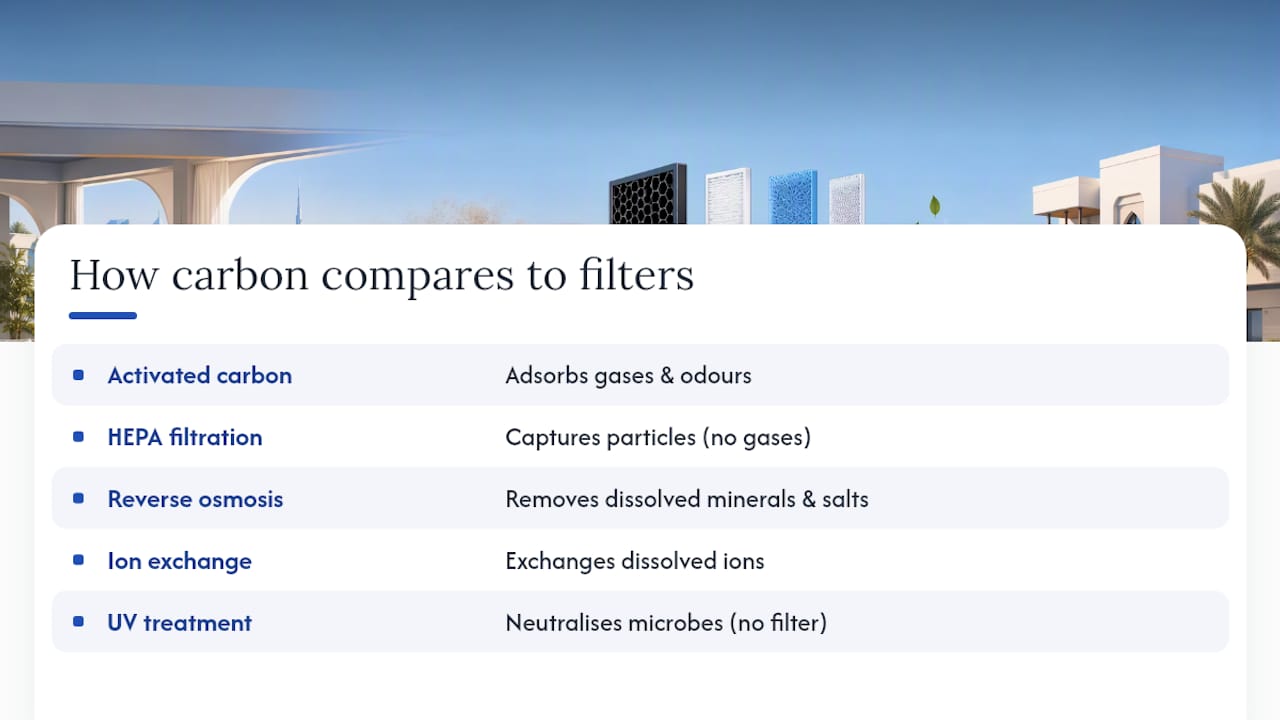
HEPA filtration captures particles, including dust, pollen, pet dander and smoke particulates, through mechanical trapping rather than adsorption. It does nothing for gases or odours, which is exactly the gap carbon fills. The two technologies are commonly paired in the same unit precisely because neither covers the other’s job.
Reverse osmosis (RO) forces water through a semi-permeable membrane fine enough to block dissolved minerals, salts, fluoride and many inorganic contaminants that carbon cannot touch. Most RO systems still include a carbon prefilter stage to protect the membrane from chlorine damage and to handle taste before the water reaches the membrane.
Ion exchange swaps unwanted dissolved ions, commonly calcium and magnesium in water softening, or nitrate in some specialty cartridges, for a different ion. Carbon has no ion-exchange capacity of its own, so hardness problems need this separate mechanism entirely.
UV treatment neutralises bacteria and viruses through light exposure rather than filtration, addressing the biological gap that plain carbon leaves wide open.
None of these technologies makes carbon obsolete. Each one covers a hole in carbon’s performance, and a genuinely comprehensive system, whether for a home’s drinking water or its indoor air, usually stacks two or three of them rather than betting everything on one.
ClimatePro’s take on choosing and maintaining carbon filters
Getting the right carbon filter usually comes down to matching the media to the actual problem rather than buying whatever is labelled “carbon” and hoping. We specialise in air purifiers and genuine replacement filters, including carbon and HEPA combination cartridges, and deliver across the Emirates. We help customers work out whether a lingering odour needs a heavier carbon stage, an impregnated media for a specific gas, or simply a more disciplined replacement schedule. If your water tastes off or a room still smells after running a purifier, testing the water or checking the exact filter specification for your model is the sensible next step before buying anything new.
— Nevel
Get the right filter without the guesswork
We stock replacement carbon and HEPA cartridges matched to specific purifier models, so you’re not stuck ordering a generic filter and hoping it fits or performs. That matters more than it sounds: a carbon cartridge sized wrong for your unit, or lacking the density needed for your odour problem, wastes money on a three-month replacement cycle that never quite fixes the smell.

For homes dealing with cooking odours, pet smells or general indoor air quality across Dubai, Abu Dhabi, Sharjah and the wider Emirates, the Honeywell Air Touch P2 air purifier combines HEPA and carbon filtration in one unit, covering both the particle and gas side of the problem this article has walked through. Browse the full air purifier range to compare models by room size and filtration stage, or check current replacement filter stock for a unit you already own. If you’re unsure which carbon type suits your specific odour or water issue, get in touch for model-specific advice before you order.
Sources
- Drinking water treatment: activated carbon filtration (University of Nebraska‑Lincoln Extension)
- Activated carbon filtration (UGA/extension circular)
- Air purifier buying guide (Consumer Reports)