
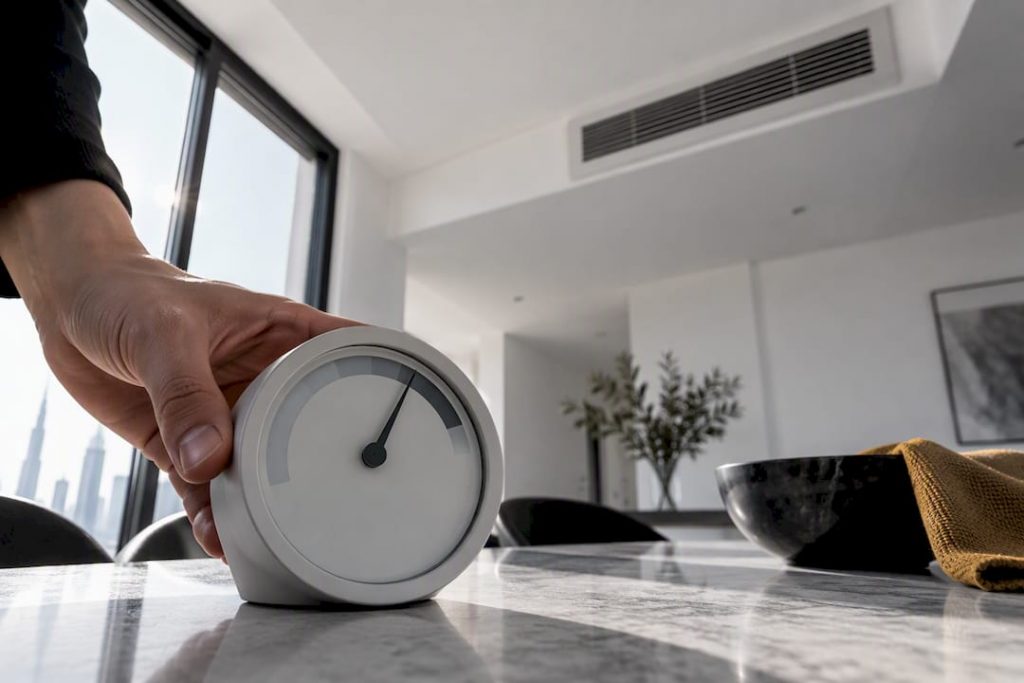
Measure your indoor humidity with a hygrometer, then try the least disruptive fix first: set your AC fan to auto, avoid extreme cooling, and add a small humidity source, such as a portable humidifier or bowls of water. These steps solve most cases of dry air within a day or two. If relative humidity stays outside the 30 to 50% comfort range, or symptoms like dry skin and irritated sinuses persist, a properly sized humidifier or a call to an HVAC technician is the next step.
TL;DR:
- Proper measurement with a hygrometer is essential before selecting a humidifier or making adjustments to avoid over- or under-humidification.
- Setting the AC fan to auto and preventing oversizing or short-cycling can significantly reduce unwanted drying of indoor air.
- A portable humidifier or simple moisture sources like bowls of water or plants are effective for mild dryness, but larger or persistent issues may require a dedicated unit.
- Maintenance, including regular cleaning and using distilled water, is crucial to prevent bacteria and mineral buildup that can worsen indoor air quality.
- For ongoing humidity control, a whole-home humidifier linked to the HVAC system is recommended in larger spaces or when consistent conditions are needed.
Table of Contents
- How air conditioning removes moisture from indoor air
- Quick fixes you can try today
- Matching the device to the problem
- Choosing and maintaining a humidifier without creating new problems
- Where ClimatePro UAE fits into the fix
- What matters most when fixing dry AC air
- Get your home’s humidity sorted with ClimatePro UAE
- Sources
- FAQ
How air conditioning removes moisture from indoor air
Air conditioners cool air by passing it over a cold evaporator coil. As the air cools below its dew point, moisture condenses on the coil and drains away, which is why an AC unit produces a steady trickle of condensate. This dehumidifying side effect is normal and often desirable in humid climates, but it can push indoor relative humidity too low, particularly when a system runs for long stretches or is oversized for the room it serves.
Several common setup issues make this worse:
- Oversized units short-cycle, cooling the room quickly and shutting off before they have run long enough to stabilise humidity properly.
- Fan set to “On” instead of “Auto” keeps air moving over a dry coil even when cooling has stopped, pulling more moisture out of the room.
- Poor airflow or blocked vents force the system to run longer to reach the target temperature, extending moisture removal time.
- Leaky ducts or building infiltration let in outside air that disrupts the balance the system is trying to hold.
Cleveland Clinic notes that the cool, dry, and recirculated atmosphere an air conditioner creates can trigger upper respiratory symptoms in some people, even though the AC itself is rarely the direct cause of illness. Maintaining a reasonable moisture level in the air matters for comfort and for reducing that kind of irritation.
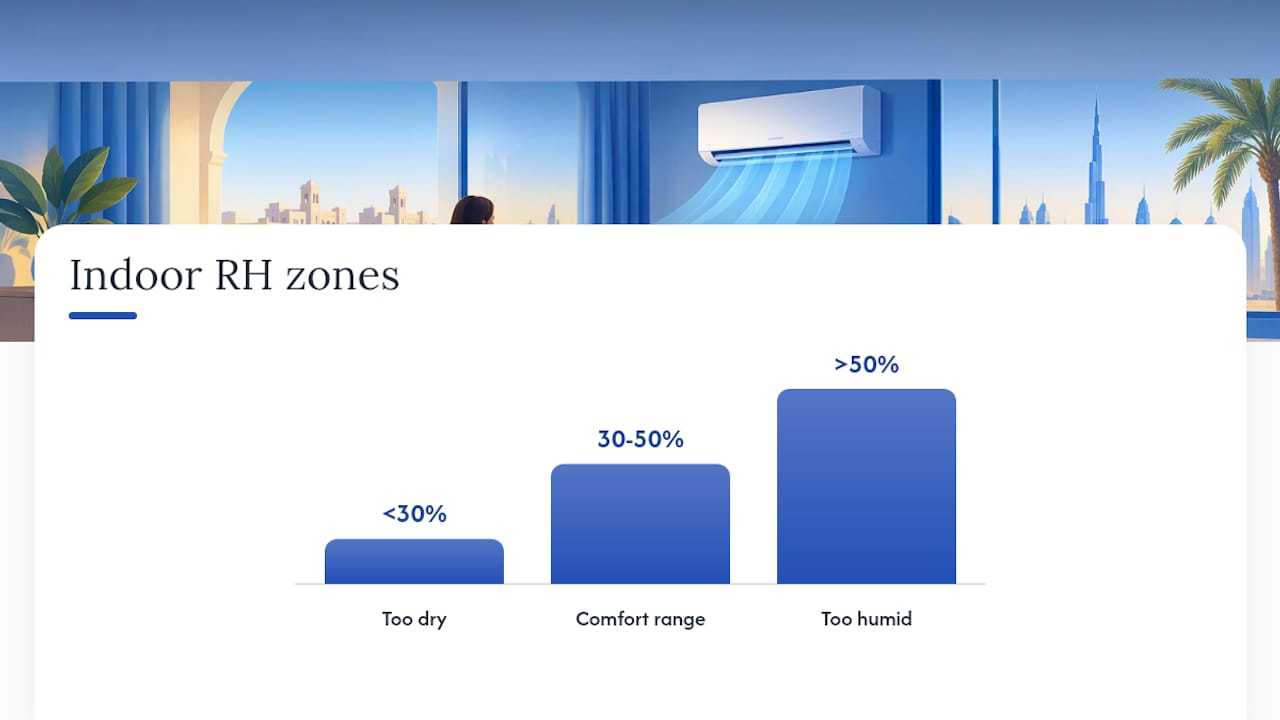
Indoor relative humidity between 30% and 50% is the range most guidance points to for comfort and health, a target referenced across ASHRAE’s mould and dampness position and Cleveland Clinic’s guidance on air conditioning and health. Below 30%, dry skin, irritated eyes, and static electricity become more common. Above 50%, the risk shifts toward condensation and mould growth, which is a separate problem with a different fix.
It is worth noting that a well-maintained AC rarely pushes relative humidity much below moderate low levels on its own. Persistent dryness usually comes from how the system is run rather than the AC as a device, according to HVAC advisories that point to runtime patterns, oversizing, fan settings, and building leakage as the more common culprits. For more on how this plays out room by room, see our breakdown of humidity in an AC room.
Quick fixes you can try today
Start with measurement, then work through these steps in order, from least to most involved.
- Measure first. Place a hygrometer in the room and record readings morning and evening for a day or two before changing anything, so you know your actual starting point.
- Adjust the AC settings. Switch the fan to auto rather than on, avoid setting the thermostat lower than needed, and use Dry Mode only for mild, short-term stickiness rather than as a constant setting.
- Add a humidity source. A small portable humidifier is the most controllable option, but bowls of water near airflow, a few leafy indoor plants, or leaving the bathroom door open after a hot shower all add moisture without extra equipment.
- Check maintenance basics. Clean or replace AC filters, clear the condensate drain line, and make sure vents and grilles are not blocked, since restricted airflow makes the system work harder and dry the air more than necessary.
- Watch for the reverse problem. If windows start fogging, surfaces feel damp, or you notice a musty smell, humidity has likely gone above the useful range and it is time to ease off.
Pro Tip: Keep the hygrometer in the room for a full week after any change, since AC dryness often varies with outdoor weather and how long the system runs each day.
Filter and drain maintenance is not a one-off task. Our guide on managing dry indoor air covers how upkeep habits interact with humidity over the course of a cooling season, which matters more in some climates than others.

Matching the device to the problem
Not every dry-air complaint needs the same fix. The table below is not needed here, since the differences come down to a short list of use cases.
- AC Dry Mode suits brief, mild humidity discomfort while the AC is already running, but it is not designed to hold a specific humidity target over time. LG’s guidance on Dry Mode versus dehumidifiers frames it as a light-touch option rather than a long-term solution.
- Ultrasonic humidifiers run quietly and use little power, but can disperse fine mineral particles, often called white dust, if filled with hard tap water.
- Evaporative humidifiers naturally self-regulate since output slows as the room approaches saturation, though they need a wick filter replaced periodically.
- Warm-mist humidifiers add a small amount of heat with the moisture, which can suit cooler rooms but uses more energy than the other two types.
- Whole-home humidifiers integrate with ducted HVAC systems and make sense when several rooms need consistent humidity control, though the installation and running cost is higher than a portable unit.
- Dehumidifiers solve the opposite problem: persistent dampness, condensation on windows, or a musty smell that signals mould risk rather than dryness.
- Air purifiers do not add moisture at all, but they can ease the irritation that dry, recirculated air causes by reducing airborne dust and allergens, which is useful when dryness and irritation show up together.
The right choice depends on how many rooms need treatment and whether the issue is occasional or constant. A single bedroom with mild overnight dryness rarely justifies whole-home installation, while a home where every room feels dry during peak cooling season might.
Choosing and maintaining a humidifier without creating new problems
Sizing matters more than most buyers expect. A unit rated for a small bedroom will not keep pace in an open-plan living area, so check the manufacturer’s coverage area in square metres against the room you intend to treat, and match tank capacity to how many hours a day you plan to run it.
- Match capacity to runtime, since a small tank that needs refilling every few hours becomes a chore fast in a larger room.
- Compare humidifier types on noise, energy use, and mineral dust: ultrasonic units are quiet but prone to white dust, evaporative units self-regulate, and warm-mist units use more power.
- Use distilled or demineralised water where possible, since the EPA’s guidance on home humidifiers points to mineral dispersal and microbial growth as the main risks of poor maintenance, and low-mineral water reduces both.
- Clean small-tank units daily and deep clean weekly, following the same EPA guidance alongside CDC advice on preventing waterborne germs, which recommends daily emptying and regular cleaning to limit germ growth.
- Consider a professional HVAC humidifier for whole-home needs, since ASHRAE’s technical guidance on humidifiers notes that humidification energy costs and performance depend on a building’s ventilation and infiltration rates, meaning a whole-home system has to be sized to the building, not guessed at.
A humidifier that is never cleaned can do more harm than the dry air it was meant to fix, since minerals and microorganisms both spread through the same mist meant to add moisture, a risk the EPA specifically calls out. Our step-by-step guide to humidifier selection and cleaning walks through the maintenance routine in more detail.
Where ClimatePro UAE fits into the fix
Suppliers offer humidifiers, dehumidifiers, air purifiers, and replacement filters, with delivery and support handled locally rather than through overseas shipping. For readers weighing a combined-function device, the Blueair 2-in-1 Purify + Humidify DH3i is one example of a unit that adds moisture and filters air in a single appliance, useful for anyone treating both dryness and dust in the same room.
The practical next step is the same one this article opened with: measure the room’s relative humidity, then browse the humidifiers category for a unit sized to that space. For rooms with the opposite problem, condensation or a musty smell rather than dryness, the dehumidifiers category covers that separately. Filters for existing purifiers and humidifiers are listed under replacement filters.
What matters most when fixing dry AC air
Most people jump straight to buying a device when a five-minute measurement would tell them whether they need one at all. The priority order is simple: measure, then try the least invasive fix, then scale up to a dedicated appliance or HVAC integration only if the numbers say so.
Energy and condensation trade-offs deserve equal weight to comfort. Running a humidifier hard enough to fight an oversized, short-cycling AC wastes power on both ends, a tension ASHRAE’s humidification guidance touches on directly.
— Nevel
Get your home’s humidity sorted with ClimatePro UAE

Fixing dry air from an AC does not require replacing the AC. Once you know your room’s actual relative humidity, choosing the right humidifier size becomes a much shorter decision, and Catalogues are organised so buyers can go straight from problem to product without guessing at specifications.
- Measure your room’s relative humidity with a hygrometer before buying anything.
- Browse the humidifiers category for a unit sized to your room and runtime needs.
- If dust or allergens are part of the problem too, the air purifiers category covers combined comfort needs.
- Local delivery and warranty support across the Emirates means no need for overseas shipping if a unit needs servicing.
Whichever unit you choose, keep the maintenance routine in mind from day one: clean water, regular tank changes, and a weekly deep clean go a long way toward getting the comfort benefit without the upkeep headaches. Visit the humidifiers catalogue to compare options sized for your space.
This article is general information, not a substitute for advice from a qualified doctor. Consult a qualified healthcare professional about your own circumstances before acting on anything here.
Sources
- ASHRAE — Humidifiers (technical guidance)
- ASHRAE position on limiting indoor mold and dampness
- Cleveland Clinic — Can air conditioning make you sick?
- US EPA — Use and care of home humidifiers
FAQ
How do you fix dry air from an AC?
Measure the room’s relative humidity first, then adjust the AC fan to auto and avoid overcooling before adding a portable humidifier or simple moisture source like water bowls or plants. If humidity stays below 30% after these changes, a properly sized humidifier or an HVAC check is the next step.
How do you stop an AC from drying out the air?
Set the fan to auto rather than continuously on, since a fan running over a dry coil keeps pulling moisture from the room even after cooling stops. Avoiding very low temperature setpoints and fixing oversized or short-cycling equipment also reduces how much moisture the system removes.
What is dry air on an AC?
Dry air on an AC refers to indoor relative humidity dropping below the comfortable range, typically under 30%, as a side effect of the evaporator coil condensing moisture out of circulating air. ASHRAE’s guidance and Cleveland Clinic both point to 30 to 50% as the healthier target range.
What is the best solution for dry indoor air?
The best solution depends on the room, but a portable humidifier sized to the space, combined with AC fan and setpoint adjustments, resolves most cases without professional intervention. For homes needing consistent humidity across multiple rooms, a whole-home humidifier integrated with the HVAC system is the more durable fix.
When should you use a dehumidifier instead of a humidifier?
A dehumidifier is the right tool when the problem is excess moisture rather than dryness, shown by condensation on windows, a musty smell, or visible mould risk. LG’s guidance notes AC Dry Mode suits only mild, short-term humidity relief, while a dedicated dehumidifier handles persistent moisture problems.