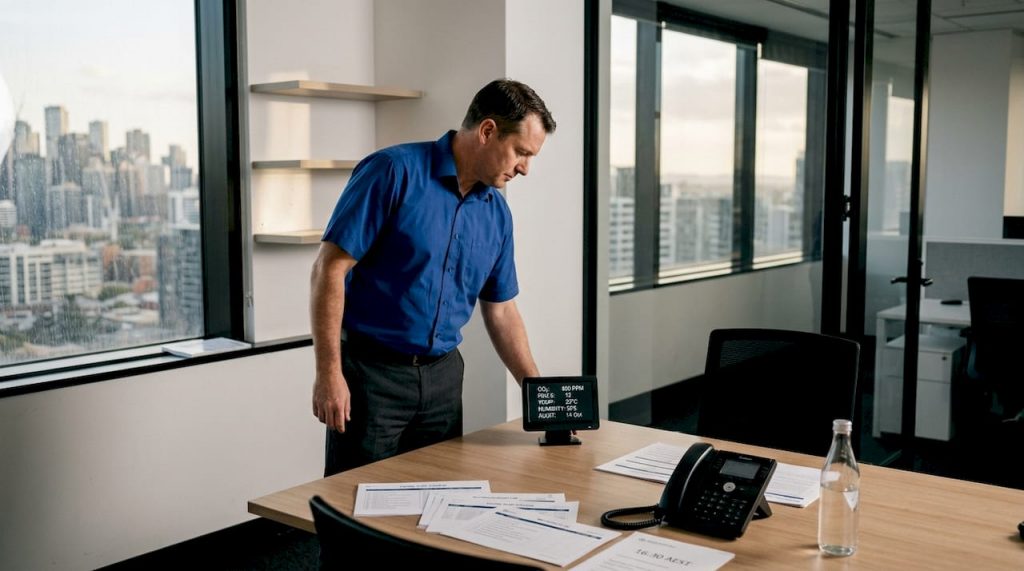
Most people assume that more ventilation automatically means cleaner, healthier air indoors. That assumption is understandable, but it is not always correct. Air changes per hour (ACH) is a foundational metric in ventilation and indoor air quality (IAQ) management, yet applying it well requires more than selecting a target number. In UAE homes and offices, where extreme heat, humidity, and outdoor dust are constant factors, getting ACH right means understanding its benefits, its limits, and how it interacts with your specific building and climate.
Table of Contents
- What is air changes per hour (ACH) and why does it matter?
- How ACH influences health, comfort, and pollutant control
- ACH, infection control, and emergency ventilation modes
- Practical considerations in the UAE: Why climate and HVAC matter
- Smart strategies for applying ACH in your home or office
- Why a ‘set and forget’ approach to ACH fails in the UAE
- Enhance indoor air quality with proven solutions
- Frequently asked questions
Key Takeaways
| Point | Details |
|---|---|
| ACH foundation | Air changes per hour (ACH) is key to understanding and managing your indoor air quality. |
| Health impact varies | Higher ACH often helps but does not guarantee fewer health risks—practical outcomes depend on many factors. |
| Balance indoor and outdoor air | Ventilation reduces indoor pollutants but can also bring outside air problems—especially during sandstorms or pollution events in the UAE. |
| HVAC integration | In the UAE, ACH must be coordinated with cooling and dehumidification for true comfort and IAQ benefit. |
| Smart monitoring | Measuring and adjusting system performance beats chasing a single ‘best’ ACH value. |
What is air changes per hour (ACH) and why does it matter?
ACH measures how many times the total volume of air inside a room is completely replaced within one hour. A room with an ACH of 2, for example, has its entire air volume exchanged twice every hour. The calculation is straightforward: divide the total airflow into the room (in cubic metres per hour) by the room’s volume (in cubic metres).
This metric is a cornerstone of ventilation design and IAQ assessment. ACH is a ventilation metric that indicates how frequently the air volume in a space is replaced, and it is used as a key parameter in IAQ and ventilation standards worldwide. Standards bodies such as ASHRAE use ACH as a reference point when setting minimum ventilation requirements for residential and commercial buildings.
“ACH is a key building block for understanding and improving indoor environments.”
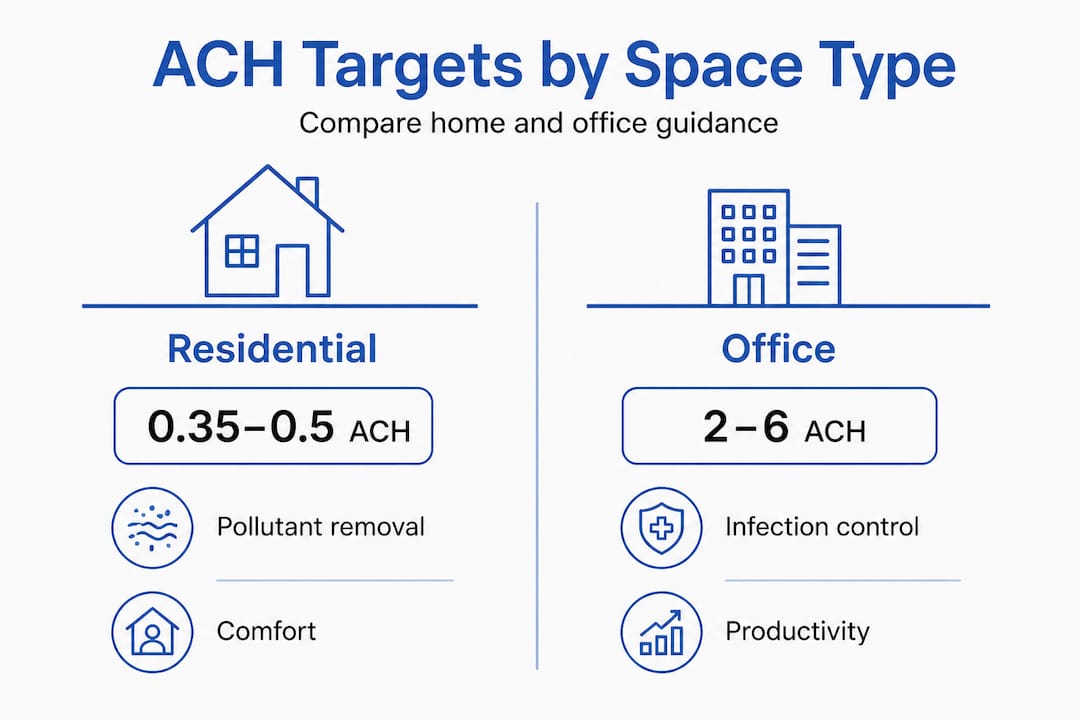
The table below shows commonly referenced ACH target ranges across different space types. These are general benchmarks, not rigid rules, and actual requirements vary based on occupancy, activity, and local conditions.
| Space type | Typical ACH target range | Primary purpose |
|---|---|---|
| Residential home | 0.35 to 0.5 | Basic pollutant dilution |
| Office space | 4 to 10 | Occupant comfort and CO2 control |
| Medical consultation room | 6 to 12 | Infection risk reduction |
| Hospital isolation room | 12 or more | Strict infection control |
| Retail or commercial space | 6 to 10 | Odour and pollutant management |
ACH is a foundation, but it is only one part of a complete IAQ strategy. For more practical guidance on managing indoor air, the air quality tips blog covers a range of relevant topics for UAE homes and offices.
How ACH influences health, comfort, and pollutant control
Higher ACH generally supports better health outcomes by diluting indoor-generated pollutants such as volatile organic compounds (VOCs) from furniture and building materials, carbon dioxide (CO2) from occupants, and moisture from daily activities. However, the relationship between ACH and health is not straightforward.
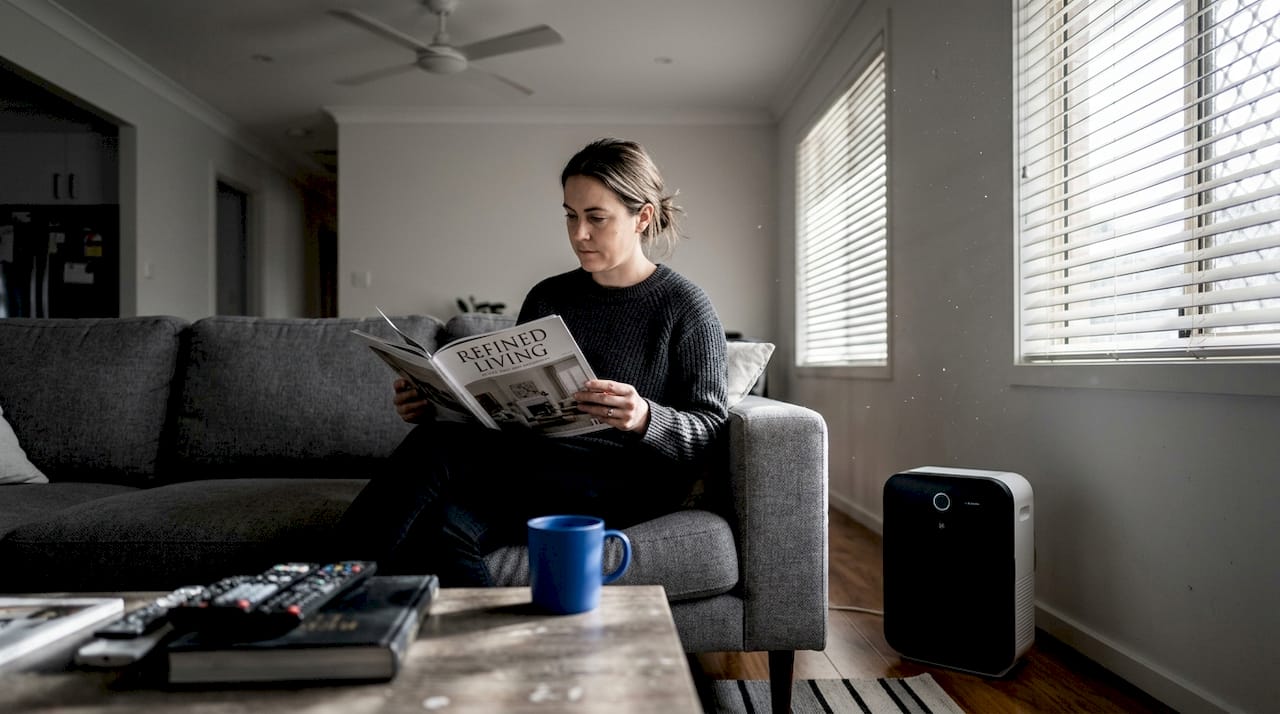
Health evidence on ACH is mixed and context-dependent. A scoping review found evidence for fewer adverse health outcomes with higher ACH in many categories, but the evidence is not always sufficient to support a single health-based ACH target for homes. This is an important finding. It means that simply increasing ACH does not guarantee a specific health benefit, and the optimal level depends on the space, its occupants, and the sources of pollution present.
There is also a less obvious downside. Increasing ventilation can reduce indoor-origin pollutants but may increase some outdoor-origin pollutants depending on conditions. In the UAE, this is particularly relevant. Outdoor air during sandstorms or periods of high traffic pollution can be significantly worse than indoor air. Bringing more of it inside without adequate filtration can worsen IAQ rather than improve it.
Pros and cons of increasing ACH:
- Pro: Reduces CO2 build-up from occupants, improving alertness and comfort
- Pro: Dilutes VOCs and odours from furniture, cleaning products, and cooking
- Pro: Lowers relative humidity when outdoor air is drier than indoor air
- Con: Can introduce outdoor dust, fine particles, and pollutants in poor outdoor air conditions
- Con: Increases cooling and dehumidification load, raising energy costs
- Con: May cause discomfort if supply air is not properly conditioned
Pro Tip: Before adjusting ventilation rates, identify the primary pollutant sources in your space. Ventilation is one tool in your IAQ toolkit. Pairing it with appropriate filtration, such as dehumidifiers for IAQ or air purifiers, often delivers better results than increasing ACH alone.
ACH, infection control, and emergency ventilation modes
ACH takes on added importance in infection risk management. During periods of elevated airborne infection risk, higher ACH rates are used to reduce the concentration of infectious particles in the air. This is why hospitals and clinics operate at much higher ACH levels than homes or standard offices.
Modern ventilation standards address this directly. ASHRAE 62.1 addenda reference infection risk management modes (IRMM) tied to ASHRAE Standard 241 requirements. These modes allow building systems to shift into a higher-performance state when infection risk is elevated. The concept of equivalent clean air (eACH) is central here. It combines the dilution effect of ventilation with the filtration effect of air cleaners to express a total clean air delivery rate, giving a more complete picture of a space’s ability to manage airborne contaminants.
How a building shifts to infection risk management mode:
- Facility managers or building management systems detect elevated infection risk, either through occupancy data, local health alerts, or CO2 and particle sensor readings.
- The HVAC system increases outdoor air intake rates, raising the effective ACH for occupied zones.
- Recirculation filtration is enhanced, using higher-grade filters or supplementary air purifiers to boost eACH.
- Outdoor air dampers are adjusted to avoid drawing in poor-quality outdoor air during dust events or high pollution periods.
- System performance is monitored continuously and settings are returned to normal operation once the risk period passes.
| Feature | Normal operation | Infection risk management mode |
|---|---|---|
| Primary goal | Comfort and CO2 control | Pathogen dilution and removal |
| ACH level | Standard design rate | Elevated, per ASHRAE 241 guidance |
| Filtration grade | Standard HVAC filters | Enhanced filtration or eACH supplementation |
| Outdoor air intake | Minimum required | Increased where outdoor quality permits |
| Monitoring | Periodic checks | Continuous sensor monitoring |
Pro Tip: If you manage an office or commercial space, ask your facility manager whether your HVAC system has emergency or IRMM settings. Many modern systems include this capability but it is rarely activated without a specific request. Pairing this with standalone air purifiers can significantly boost eACH in high-occupancy meeting rooms or reception areas.
Practical considerations in the UAE: Why climate and HVAC matter
The UAE’s climate creates conditions that make standard ventilation guidance difficult to apply directly. Summer temperatures regularly exceed 45°C, and coastal areas experience high humidity for extended periods. Every cubic metre of outdoor air brought inside must be cooled and dehumidified before it is comfortable to breathe. This places a significant load on air conditioning systems.
In humid, hot climates like the UAE, comfort and IAQ outcomes depend heavily on how ventilation interacts with cooling and dehumidification. Studies in hot climates emphasise diagnosing HVAC system limits and ventilation scheduling, not just setting a number for ACH. A building that theoretically achieves 6 ACH but whose air handling unit is undersized for the outdoor air load will deliver poorly conditioned air, leading to discomfort and potential moisture problems.
Common challenges in UAE buildings:
- Older or undersized HVAC systems that cannot handle increased outdoor air volumes without losing cooling capacity
- Inadequate filtration on fresh air intakes, allowing fine dust and sand particles to enter the building
- Poorly scheduled ventilation that runs at full capacity during peak outdoor heat, wasting energy and stressing equipment
- Insufficient humidity control, leading to condensation on surfaces and elevated mould risk
- Lack of CO2 or humidity sensors, meaning ventilation rates are set by assumption rather than actual need
The table below illustrates how different fan and ventilation schedules affect both comfort and IAQ outcomes in a typical UAE office setting.
| Ventilation schedule | Energy impact | IAQ benefit | Comfort outcome |
|---|---|---|---|
| Continuous full operation | Very high | Good pollutant dilution | Risk of overcooling or humidity issues |
| Demand-controlled (CO2 sensors) | Moderate | Targeted and efficient | Good, responds to actual occupancy |
| Timed operation (off-peak hours) | Low to moderate | Moderate, depends on timing | Good if scheduled around occupancy |
| Minimal operation only | Low | Poor, CO2 and VOC build-up | Uncomfortable, especially in crowded spaces |
Pairing ventilation scheduling with humidity management tools such as humidifiers for UAE climate helps maintain comfort when ventilation rates are adjusted seasonally or in response to outdoor conditions.
Smart strategies for applying ACH in your home or office
Knowing the theory is useful. Applying it in a real UAE building requires a structured approach. The following steps provide a practical framework for homeowners and office managers.
- Measure your current ACH. Use CO2 trends as a proxy. If CO2 levels rise steadily during occupancy and take a long time to return to baseline, your ACH is likely insufficient. Formal measurement requires airflow testing by an HVAC technician.
- Identify your primary pollutant sources. New furniture, cleaning products, cooking, and high occupancy all generate different pollutants. Knowing your sources helps you decide whether ventilation, filtration, or source control is the right first response.
- Assess your HVAC system’s capacity. Check whether your system can handle increased outdoor air without losing cooling or humidity control. This is especially important in older UAE buildings.
- Adjust ventilation schedules based on occupancy and outdoor conditions. Avoid running maximum ventilation during peak outdoor heat or dust events. Use demand-controlled ventilation if sensors are available.
- Verify outcomes with measurements. After making adjustments, measure CO2, humidity, and temperature to confirm that changes have improved conditions. Occupant feedback is also a valid indicator.
- Iterate regularly. Seasonal changes in the UAE are significant. What works in winter may not work in summer. Review your ventilation settings at least twice a year.
Benchmarking for office managers should focus on operational verification through sensors, commissioning, and testing rather than design assumptions. Real-world IAQ may not match what was assumed at design stage, so measuring CO2 and humidity and checking system performance is essential. For additional guidance, the indoor air quality guides on the ClimatePro UAE website cover practical steps relevant to UAE conditions.
Pro Tip: Do not chase the highest possible ACH. The goal is to find the balance that delivers comfort, health, and energy efficiency for your specific space and occupancy pattern. More is not always better, especially when outdoor air quality is poor or your system is not sized to handle the load.
Why a ‘set and forget’ approach to ACH fails in the UAE
Most ventilation guides present ACH as a target to hit and maintain. Set the system to the right rate, and the job is done. In practice, this approach consistently falls short in UAE buildings, and the reasons are worth examining carefully.
Buildings in the UAE face a combination of conditions that make static ACH targets unreliable. Outdoor air quality varies dramatically, from clean winter mornings to severe dust events that reduce visibility to near zero. Occupancy patterns in offices shift with hybrid work arrangements and seasonal staff changes. HVAC systems age and lose efficiency, often without building managers realising it. A target ACH set at commissioning may bear little resemblance to what the system actually delivers two or three years later.
We have seen buildings that met textbook ACH targets on paper but delivered poor occupant comfort and unexpected pollutant spikes during outdoor air quality events. The issue was not the target itself but the absence of ongoing monitoring and adaptive controls. When the system was running as designed, results were acceptable. When outdoor conditions changed or equipment degraded, there was no mechanism to detect or respond to the change.
The lesson is that continual monitoring, adaptive controls, and scheduled maintenance matter far more than hitting one ACH figure. CO2 sensors, humidity monitors, and particle counters provide the feedback needed to manage IAQ dynamically rather than by assumption. This is not a complex or expensive undertaking for most homes and offices. It is a shift in mindset from a one-time setup to an ongoing management practice.
The practical IAQ insights available from ClimatePro UAE reflect this approach, emphasising measurement and adaptation over fixed targets. The UAE’s climate demands it.
Enhance indoor air quality with proven solutions
If you are ready to act on the strategies covered in this article, effective tools are available to support better ACH management and overall IAQ in your home or office.

ClimatePro UAE offers a range of products designed to complement your ventilation strategy. The Honeywell Air Touch P2 Air Purifier is a strong choice for boosting eACH in living rooms, bedrooms, and office spaces, delivering HEPA-grade filtration that captures fine dust, allergens, and airborne particles common in UAE environments. For spaces where ventilation alone cannot achieve adequate clean air delivery, exploring the full air purifiers range provides options suited to different room sizes and occupancy levels. ClimatePro UAE delivers across Dubai, Abu Dhabi, Sharjah, and all other emirates, making it straightforward to equip your space with the right solutions.
Frequently asked questions
What is a recommended ACH for homes in the UAE?
There is no single health-based target for homes, but ASHRAE 62.2 sets 0.35 ACH as a minimum for residences; values between 0.35 and 0.5 are commonly referenced, though local conditions and system capabilities should always guide the final setting.
Does increasing ACH always improve air quality in the UAE?
Not always. Increasing ACH can reduce indoor pollutants, but higher ventilation rates may bring in outdoor dust or pollutants when outdoor air quality is poor, making filtration an essential companion to ventilation in UAE conditions.
How can I measure ACH in my home or office?
Measure airflow rates and room volume, or track CO2 concentration trends to estimate how quickly air is being exchanged. For accurate results, consult an HVAC technician who can conduct formal airflow testing.
What is equivalent ACH (eACH)?
Equivalent ACH measures the combined clean air delivery effect of both ventilation and filtration. eACH links ventilation and filtration to ASHRAE 241 concepts, offering a more complete picture of a space’s ability to manage airborne infection risk beyond ventilation alone.
How does humidity affect the best ACH in the UAE?
Higher ventilation rates increase the cooling and dehumidification load on HVAC systems. In hot, humid climates, proper ACH must be balanced against system capacity and comfort requirements, making humidity control an integral part of any ventilation strategy.
Recommended
- Air Quality Blog — Tips & Guides | ClimatePro UAE
- Air Purifiers, Humidifiers & Filters UAE | Dubai & Abu Dhabi | ClimatePro UAE
- Buy Medify Air MA-35 Wall-Mount Air Purifier in Dubai | Best Price AED 521 | ClimatePro UAE
- Buy Honeywell Air Touch V2 Air Purifier in Dubai | Best Price AED 361 | ClimatePro UAE